

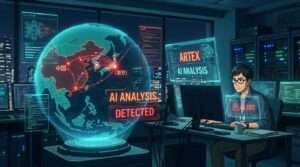
On October 19, the GMO Cybercrime Countermeasures Center, part of GMO Internet Group, announced that the China-developed AI tool ARTEX had been used in a series of unauthorized intrusions targeting Japanese companies.
The center said it had also newly identified six pieces of AI-enabled attack infrastructure targeting Japanese companies. At a news conference on the 20th, Chief Cabinet Secretary Minoru Kihara said the government would work to establish who was behind the attacks, including the possibility of involvement by foreign entities.
An era in which AI handles the groundwork for attacks
ARTEX is an autonomous AI penetration-testing tool. Penetration testing involves looking for weaknesses in a system and trying to determine whether it can actually be breached. It is a method normally used by defenders to check the security of their own systems.
ARTEX works with large language models (LLMs) to automate the search for weaknesses and attempts to gain access. It was originally released as open-source software, but its developers withdrew it after reports that it had been misused in attacks.
A tool for testing can also become a tool for attacking—a similar dual use to a kitchen knife, which can be used for cooking or as a weapon. One difference is that, by taking work off human hands, AI could allow a single attacker to target more victims.
What the investigation revealed about targeted attacks
In an earlier investigation, the GMO Cybercrime Countermeasures Center said analysis of forensic logs—in other words, data recording traces of intrusions—suggested that AI had likely been used. The center’s examination of attack-source infrastructure has now confirmed the use of ARTEX, corroborating that assessment.
One piece of attack-source infrastructure examined had targeted about 20 Japanese companies, including nine websites in the same industry. Within the scope of what could be observed, the targets were concentrated almost entirely among Japanese companies. The six additional infrastructure nodes found were each primarily aimed at particular sectors: digital gifts and retail and distribution; education, gifts and printing; points and gifts and marketing; insurance and finance; and e-commerce, media and logistics.
Eight of the Japanese companies confirmed as targets announced information leaks between September and October. Investigators believe the same attack group was involved in multiple incidents and shared the information they obtained with law enforcement.
Similar activity has been reported overseas. U.S. company CrowdStrike reported that ARTEX was used in an attack targeting South Korean financial institutions. It said the attackers’ server contained ARTEX configuration files and session history from the AI development tool Claude Code. The GMO Cybercrime Countermeasures Center believes the same methods were also used in attacks on Japanese companies.
How to interpret the string of data-leak reports
In Japan, news reports about personal information leaks have been appearing almost daily. Recent cases include the possible leak, through unauthorized access, of 730 records related to Fuji TV program-promotion staff, and the leak of 4.45 million personal records from Furusato Choice. Reports attributed both incidents to unauthorized access.
Another perspective is how to interpret the numbers. The scale is vastly different between 730 records and 4.45 million, but the severity of the harm is not determined by the number of records alone.
The risk of secondary harm, such as impersonation or fraudulent solicitation, varies depending on the type of information exposed, such as names, addresses and email addresses. News reports have also advised people to start by changing their passwords if their personal information is leaked. Users can begin with basic precautions, such as not reusing the same password.
What matters is how quickly an attack is detected—not just what happens afterward
The government said it was gathering information from relevant ministries and agencies and conducting direct interviews with affected companies. However, it said it was not yet in a position to make definitive statements about the details of the incidents. Identifying those behind the attacks remains a task for the future.
There has also been activity in the private sector and politics. On the 20th, the Liberal Democratic Party drafted a proposal calling on the government to strengthen measures against cyberattacks targeting businesses. The proposal includes introducing an AI-powered “supply-chain monitoring network” to detect anomalies early, with the aim of protecting small and midsize companies struggling with staff shortages. The party plans to finalize the proposal and submit it to the government soon. The government says it will consider new measures based on the proposal.
If attackers are automating their operations with AI, defenders cannot keep up by relying on human effort alone. The proposal’s call for AI-powered early detection can be seen as a sign of that sense of urgency. In supply-chain attacks, where harm can spread through business partners, a system that monitors anomalies across multiple companies can be effective, rather than waiting for one company to notice a problem.
Completely preventing attacks is becoming increasingly difficult. That makes how much companies and the government can shorten the time it takes to detect an intrusion—and the initial response after detection—a likely deciding factor in protecting personal information going forward.







Comments