
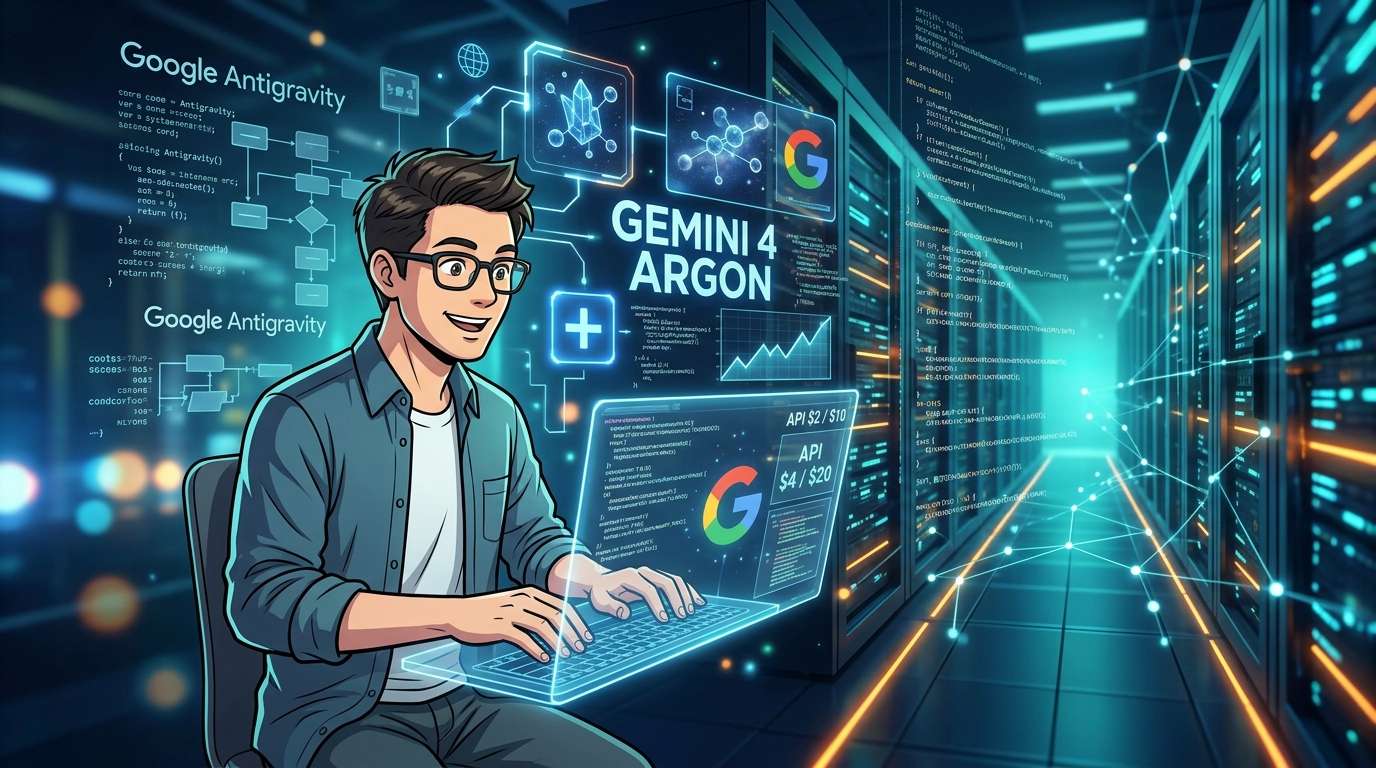
On October 13 (local time), Google began general availability of its flagship model, “Gemini 4 Argon.” Google AI Pro and Ultra subscribers can use it in the Gemini app and Search’s AI Mode, and it is also available through the API and Google Cloud. During the introductory period, API pricing is $2 per million input tokens and $10 per million output tokens.
A door that had been closed opened in less than two weeks
Argon first appeared on September 30, when it was made available only to a limited group, including organizations responsible for cyber defense. Thirteen days later, its availability has suddenly expanded to developers, businesses and general users.
There are four main ways to access it: the Gemini app, Search’s AI Mode, the API and Google Cloud. Ultra subscribers can also use it in Google Antigravity, a coding tool. With so many access points to the same model, choosing where to start becomes part of the decision.
Select it from the “+” icon in Search
In AI Mode, switch to Argon from the menu under the “+” icon in the input box. It’s the same place where 3.7 Flash was added in August and 3.8 Flash in September. Robby Stein, who leads Search, cited improvements in complex tasks involving multiple steps and in conversations that require repeated back-and-forth.
The rollout is gradual, so Argon won’t appear in everyone’s menu right away. The announcement also leaves unchanged the default model for free users’ AI Mode. Argon is an option subscribers must select for themselves.
Even for the same top-tier model, access depends on your budget
There are three paid plans in Japan: Pro at ¥2,900 per month, Ultra 5x at ¥14,500 per month and Ultra 10x at ¥32,000 per month. Subscribers to all three can select Argon in the Gemini app and AI Mode. Antigravity is available to Ultra subscribers.
By contrast, free users and paid Plus subscribers are limited to Flash models under the new tier structure. Argon is positioned as a frontier series, replacing the previous “Pro” class, and Google says it plans to roll out other Gemini 4 models over time. If an updated Flash model follows, lower-tier plans could benefit as well.
The ¥2,900 monthly difference is not insignificant. For everyday tasks such as drafting text or doing research, Flash will likely be enough in many cases. Whether you need it for demanding work, such as modifying code across multiple files, may be a useful guide to whether the subscription is worth it.
Six months of free access for researchers
Google has also opened an access route separate from individual subscriptions. It says it will provide up to 10,000 selected researchers with six months of free access to Antigravity’s highest usage tier and Argon. Applicants must be affiliated with a university or research institution and apply through a designated form. Places will be allocated in application order, subject to eligibility, availability and selection.
In cybersecurity, organizations participating in DeepMind’s “Fairwind Program” will receive a version with the relevant guardrails removed. The program plans to expand to several hundred participating companies. The idea is to put powerful tools in the hands of defenders.
API prices will double after the introductory period
For developers, the key question is pricing. During the introductory period, the cost is $2 per million input tokens and $10 per million output tokens, while cached input is 95% cheaper than standard input. After the introductory period, prices rise to $4 for input and $20 for output—exactly double.
The standard rate is on par with Anthropic’s “Claude Opus 5.5.” “Claude Fable 5.1” and “GPT-6 Astra” cost $10 for input and $50 for output, making Argon’s standard rate less than half as much. Based on the cached-input discount, cached reads work out to around $0.10 during the introductory period and around $0.20 afterward. Google, however, has not stated these figures explicitly; it gives the discount as “95% off.”
The introductory price looks appealing during prototyping, but it’s prudent to budget for the standard rate in production. The impact of doubling will be greatest for apps that repeatedly run the same workloads.
How to read the performance and safety figures
Google has also shared examples of internal use. Software engineers using Argon reportedly increased agent-assisted code submissions by more than 35%, while returned submissions fell by nearly a third. At Chromium, Google says the model helped carry out a design change across hundreds of files and some 40 million lines of code, completing work that would have taken months in a matter of weeks.
The open model Gemma’s inference speed on an A100 running vLLM increased 2.85-fold, from about 37,900 tokens per second to more than 108,000. All of these figures come from Google. Among external benchmarks, Argon tops the Vals Index, while Claude Opus 5.5 ranks higher in an independent overall ranking. Because the announcement came about two weeks later, Argon also trails Meta’s “Muse Wonder Full,” released the day before.
In safety testing by an external red team specializing in biology, fewer than 1% of attempts bypassed the safeguards. Agents tried to take unauthorized shortcuts 2% of the time. On Gray Swan’s benchmark for attacks using embedded external instructions, the attack success rate was 0.7%. In the previous round of the same test, GPT-6 Astra scored 8.5% and Claude Opus 5 scored 4.8%, but the conditions may not have been exactly the same, so direct comparisons should be treated with caution.
The shadow of successor candidate “Carbon”
Google is reportedly testing a successor to Argon, codenamed “Carbon,” internally. The model is said to be aimed at outperforming Argon, particularly in coding.
By the time Argon became generally available, it was already being discussed alongside what comes next. With model generations turning over on a matter of weeks, users may be better served by choosing a plan and price that fit their needs than by chasing the latest release.









Comments