
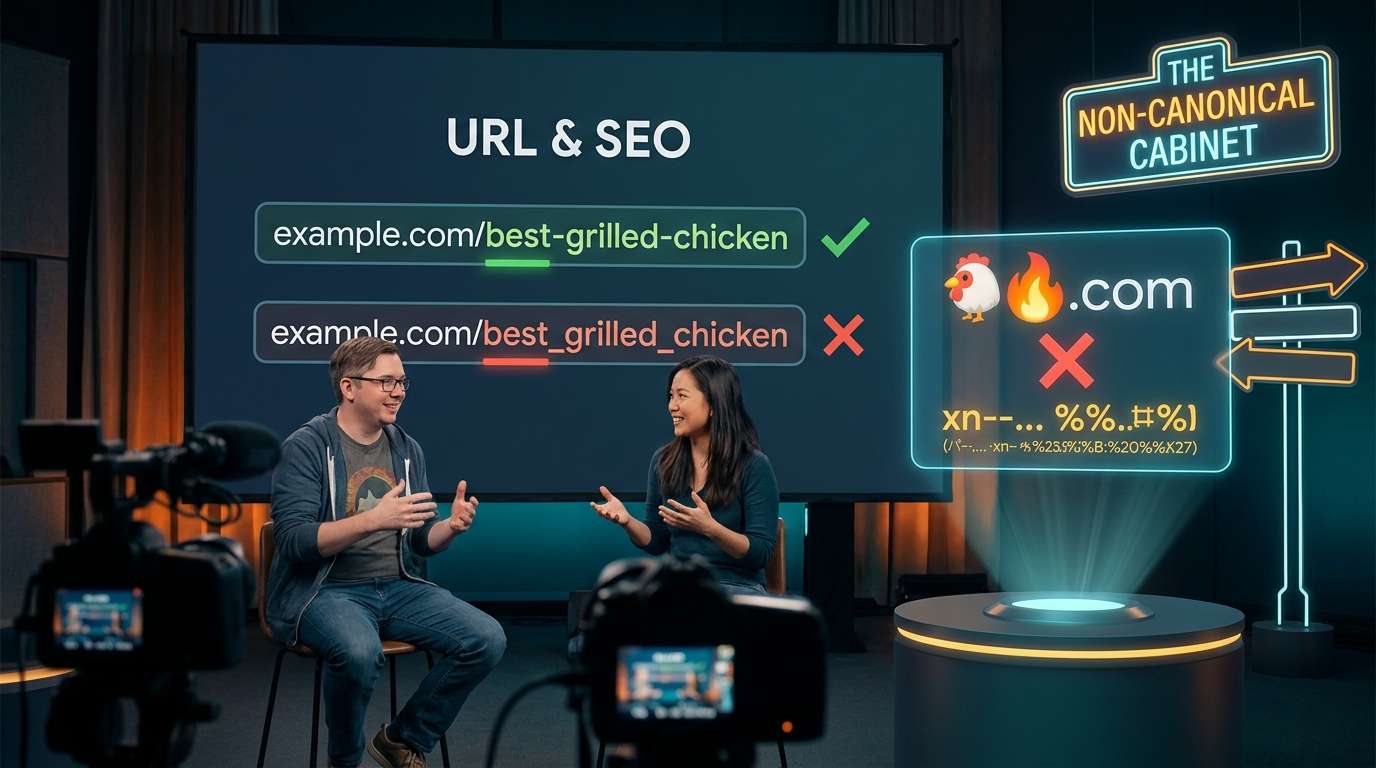
In the first video in its new series, “The Non-Canonical Cabinet,” Google discussed how URLs are handled in search. The speakers were Gary Illyes and Cherry Prommawin. They said that keywords in URLs or domain names have a “very small” effect on rankings and recommended using hyphens to separate words. They also touched on URLs containing emoji and percent encoding.
What Became of the Idea of Stuffing Keywords Into URLs
Listing a string of target search terms in a single URL, as in “best-grilled-chicken-cheap-delicious.” Anyone who has spent time on SEO has probably seen this at least once. This very idea was one of the topics of the video.
Illyes said that keywords in URLs or domain names are a “very small” ranking signal and are unlikely to have much effect. He added that Google can detect spammy use of keywords in URLs. In other words, adding more words does not give you an advantage.
This view is not actually new. Search Engine Roundtable has repeatedly covered past Google statements that keywords in URLs have little impact, that some SEO professionals focus too much on URL structure, and that URLs should not be changed for ranking purposes. This video revisits those points from a technical perspective, explaining how URLs are processed.
Not a Ranking Badge, but a Signpost Showing Where You Are
Does that mean you don’t need to give URLs any thought? Probably not. In my view, a URL is less a badge that boosts rankings and more a signpost that tells people and machines where a page is.
When someone sees it in search results or a social media post, they should be able to get a sense of what the page contains. Colleagues should also be able to identify the article. Readability and ease of management have value separate from rankings. In practice, it is likely more useful to maintain a consistent, concise structure that makes sense than to spend time deciding how many keywords to include.
The same reasoning has been applied to avoiding frequent changes to published URLs solely for ranking purposes. Google representatives have repeatedly urged site owners not to change URLs “just for SEO.”
Use Hyphens to Separate Words—a Point the Video Also Clarifies
Another key topic in the video was the choice between hyphens and underscores. Illyes said to use hyphens to separate keywords in URL paths and avoid underscores. The article covering the video described the matter as “settled.”
This topic has a long history, too. Matt Cutts once recommended using dashes, while John Mueller said in another instance that he did not worry about the difference between separators. Although the guidance may have seemed to shift over time, the video clearly recommends hyphens. If you are designing a new URL, sticking with hyphens should make the choice straightforward.
Behind Emoji URLs and Internationalized Domains
The video also covered a few more playful topics, including which characters can be used in domain names, internationalized domain names and Punycode, and why strings beginning with “xn--” are not typos. Asked whether an emoji domain ending in “.com” could exist, the answer was no.
When emoji are used in a URL path, they are converted into a different string through a process called percent encoding. They may look cute, but when shared, they can turn into an unreadable string of symbols. The accompanying article even joked that this could ruin a second date.
This is relevant to anyone running a multilingual site or using Japanese URLs. It may be worth reviewing your site’s URLs with an eye toward prioritizing usability and ensuring they remain intact when pasted elsewhere over visual novelty.
Three Things to Keep in Mind When Designing URLs
Applied to day-to-day work, the video’s points boil down to three things. First, stuffing keywords into URLs is not worth it as a ranking tactic. Second, use hyphens to separate words. Third, before adopting special characters such as emoji, consider how they will look after conversion.
URLs are an unglamorous element, but once published, they are not easy to change. Rather than expecting them to work ranking magic, decide from the outset on a structure that is readable and easy to manage. That is the practical guidance to take away from the video.








Comments