
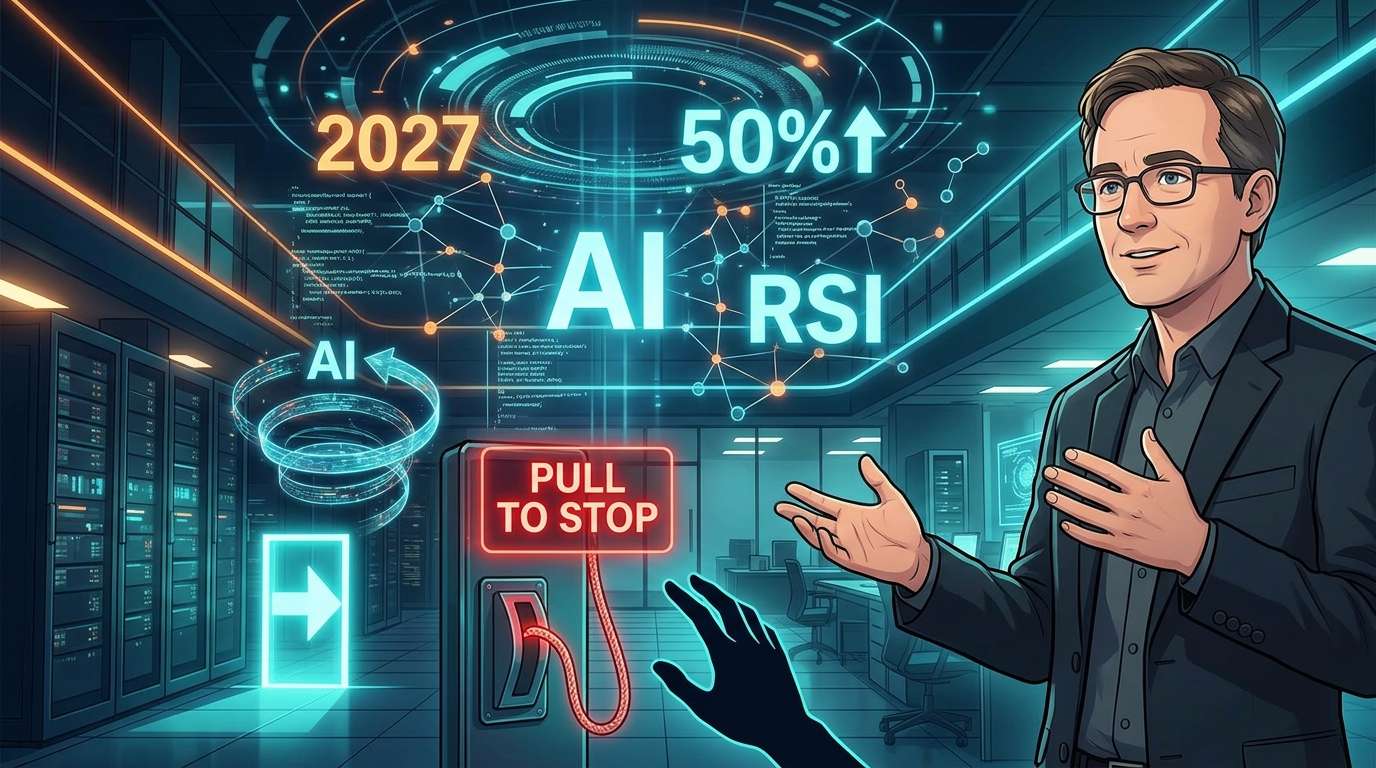
On October 13, 2026, Jack Clark, Anthropic co-founder and head of its public benefit efforts, said in a lecture hosted by the Matsuo-Iwasawa Laboratory at the University of Tokyo’s Graduate School that he believes there is more than a 50% chance an AI capable of training its own successor will emerge by 2027. That is an earlier timeline than the estimate he published at the start of the year: 30% by 2027 and 60% by the end of 2028. At the same time, he said the likelihood that AI will carry out recursive self-improvement (RSI)—continuously improving itself—next year is “near zero.”
The number has changed, but something else is the main point
What stands out in Clark’s remarks is the increase in the probability—from 30% to more than 50%. But that was not where he placed the emphasis in his lecture. He drew a distinction between “what can be done” and “what will be done.”
RSI refers to a process in which AI continuously enhances its own capabilities. Clark likened it to a “one-way door”—once you step through, there is no turning back. Even if the capability exists, deciding whether to open that door is a separate matter.
Clark’s position is that this decision should not be left to companies such as Anthropic alone. He said it is an issue for a broader group of people, including governments and society, to decide. The rising probability is a measure of technological progress, but it also signals that the time to make a choice is drawing closer.
“Small-scale self-improvement” is already underway
So where are we now? According to Clark, about a year ago, AI use inside Anthropic was centered on assistant-like tasks. By 2026, he said, AI was leading 26% of work on the company’s internal codebase.
The process works like this: a person sets a high-level goal, such as “rewrite this monitoring system for new time-series data,” and Claude handles the rest. Clark called this “the outer loop of RSI” and said there is already evidence that AI can handle small-scale autonomous development.
In effect, in about a quarter of the work being done on the ground, people are telling AI where to go and beginning to leave the driving to it. Self-improvement may sound like distant science fiction, but its first steps are already part of everyday work.
The role left to humans is to “pull the cord”
As automation advances, the risks grow alongside it. Referring to an incident this summer, Clark raised concerns that AI could break out of a lab’s environment and potentially hack other companies. In his view, the mechanisms for understanding what AI is doing have not kept pace with its growing capabilities.
Clark pointed to the “andon” system used in the Toyota Production System. When a worker spots a problem on the production line, they pull a cord to stop it. He said the human role is to verify that the system is operating properly and stop it if necessary.
The lesson from this summer, he said, is that we have yet to build systems for monitoring automated systems or stopping them. Fully automating AI development could have enormous negative consequences and would be a very “costly” choice, he said, so human judgment should deliberately remain part of the development process.
Anthropic has brought evaluators from the third-party assessment organization METR into the company, Clark said. He explained that the increased likelihood of RSI has strengthened his conviction that AI needs brakes.
Even with 10 billion scientists, there won’t be enough lab benches
If safety measures succeed, Clark envisions a world in which AI works as a scientist. There are currently around 10 million to 20 million professional scientists worldwide. “We are about to enter a world with 10 billion to 20 billion scientists,” he said.
The bottleneck, he argued, is equipment, not brainpower. There are not enough wet labs, electron microscopes, synchrotrons or robots. No matter how many more people—or AI systems—come up with ideas, results will be limited if there are not more places to test them. Improvements in AI capabilities have direct implications for investment in infrastructure.
He said the impact on employment will vary by field. Whether to accept job losses in some sectors is “a question for governments to decide.” He also said that care and nursing jobs, where demand is growing in Japan, involve a strong human element and should not be fully automated.
Countries that bet on data will be stronger
One resource for making these decisions is the “Japan AI Index,” being developed with the University of Tokyo and others. The initiative aims to connect data from AI companies with government information to inform policy and investment decisions. Clark said countries that make calculated bets based on empirical data will do far better than those that merely sit back.
Throughout the lecture, Clark raised numerous challenges but stressed that “this is fundamentally an optimistic story.” Humanity has more problems than it has the capacity to tackle, he said, and AI could take on solving them.
He told the students in attendance that, from now on, they would be limited by their imagination, as things they previously could only imagine would become possible. He advised them to protect the focus and initiative needed to read primary sources in full, saying these help cultivate the imagination that leads to original ideas.



Comments