
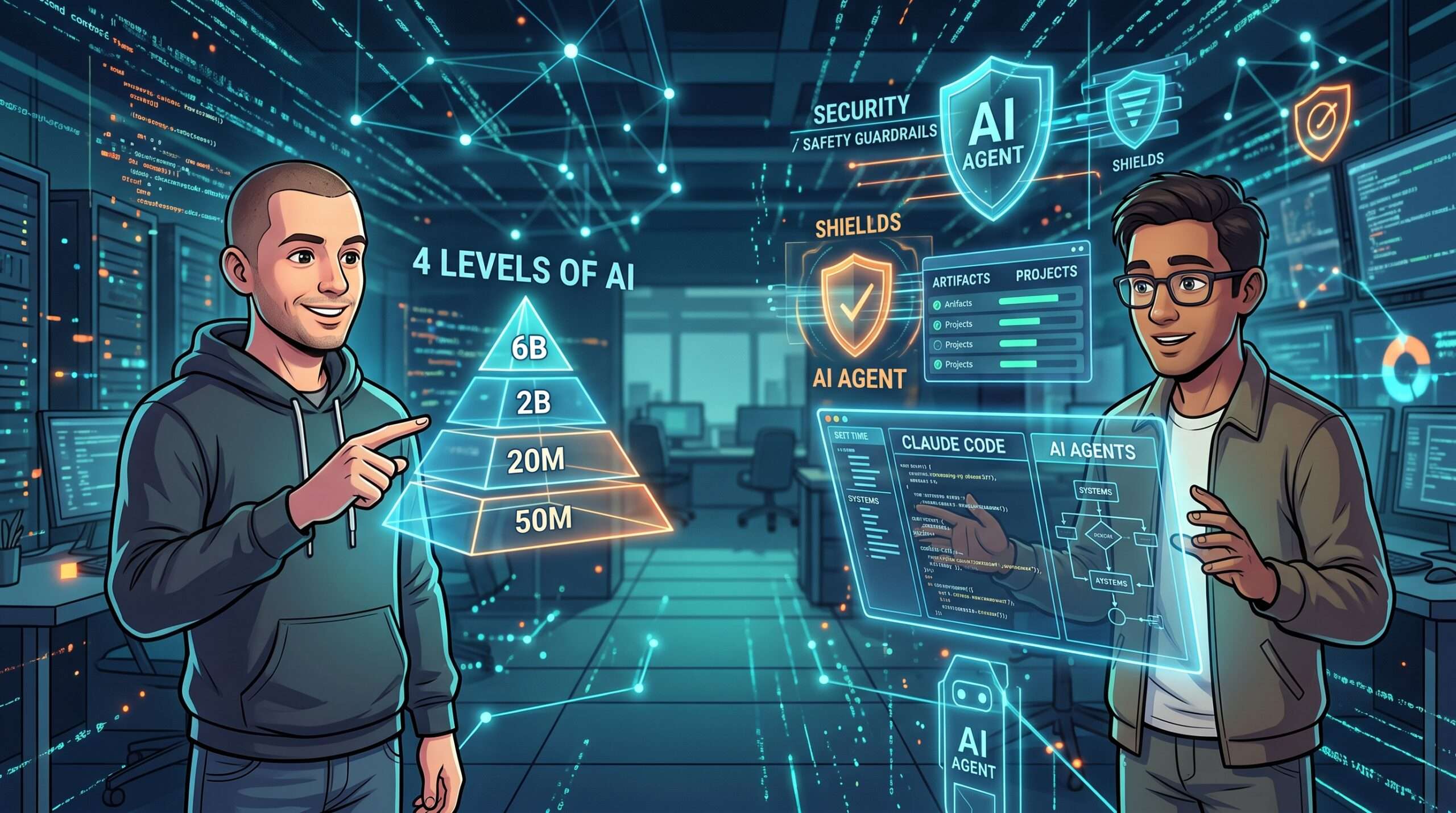
Andrej Karpathy, a former OpenAI co-founder who is now at Anthropic, divided users of large language models (LLMs) into four tiers, noting that the gap in perceptions of AI’s capabilities is widening. Around the same time, Anthropic’s Tariq Shihipar discussed how to use the development tool Claude Code, its planned features, and agent safety measures on a podcast.
People see different things, even when looking at the same AI
Is AI an extension of search, or a partner you can hand an entire job to? The four-tier classification Karpathy shared on X puts numbers to this disconnect.
The largest tier comprises about 6 billion people who have barely used LLMs, or roughly 75% of the world’s population. Above them are 1 billion to 2 billion people who use free chat services as a substitute for search or to help with writing.
The third tier consists of about 20 million people who use cutting-edge models for work in mathematics and programming, representing roughly 0.2% of the world’s population. At the top are about 5,000 people with access to cutting-edge systems within their organizations—around 0.00006% of the population. These are Karpathy’s estimates, not statistics based on a survey.
What is interesting is that the differences between tiers are not determined solely by how much people know. Karpathy wrote that in professions where interaction with people is central, such as management, even those who understand AI’s progress intellectually may have little more than secondhand knowledge of it. The same word, “AI,” can mean different things to people who use it hands-on and those who only hear about it.
Work that once took weeks can now get underway with a single instruction
As examples of the changes experienced by experts in the third tier, Karpathy cited developing new apps, cloning and porting them, and decompiling binaries. He said agents can now complete large-scale tasks that once took weeks or months with a single instruction. An agent is an AI that does more than answer questions: it uses tools to carry out multiple steps on its own.
Karpathy’s own views changed quickly. In October 2024, he described AI agents as “mostly marketing hype that barely works.” A few months later, he said he had stopped writing code by hand.
The roughly 5,000 people in the top tier are seeing what comes next. The picture includes scenarios such as thousands of agents working for weeks on large-scale software development. As Karpathy put it, what people can see from the outside is merely a trailer.
Progress is strongest in fields where results are easy to verify
Karpathy said LLMs are particularly capable in fields that are “digital, verifiable, and economically valuable.” Tasks with mechanically checkable answers are easier to improve through reinforcement learning, and companies also direct training resources toward profitable areas. Programming and mathematics are two fields that fit the bill today.
OpenAI CEO Sam Altman also said at the G20 Innovation Ministers’ Meeting in early September that current coding tools can build in 17 minutes what a startup took three months to make.
Human understanding is struggling to keep up
Karpathy also noted that human review and understanding are beginning to fall behind. He cited people who are still digging into events related to OpenAI from several months ago, as well as the fact that it may take mathematicians some time to work through 722 manuscripts on frontier mathematics.
To the general public, AI looks like an “awkward chatbot”; to many professionals, it offers “a moderate boost”; and to some experts, it is “the dizzying sensation of a curve rising vertically.” Karpathy calls the simultaneous unfolding of these three realities “the weirdness of the present.” For more details, seeThe Decoderreports.
The gap in AI proficiency shows in how people give instructions
The more work people can delegate, the more their own skills matter. On the podcast “Latent Space,” Anthropic’s Tariq Shihipar said that writing prompts remains one of the most effective skills for using Claude Code. He said experienced users have an intuitive mental model of Claude and can tell how much it can accomplish from a single instruction.
The discussion also touched on how recognizing what you do not know becomes more important as agents grow smarter. One point raised was that the results can vary significantly depending on how much time you spend on the initial explanation.
Seen in a different light, giving instructions to AI is shifting from learning how to operate a tool toward designing work. What should be built, what should take priority, and how much should be checked? Any decisions people leave open will be filled in somehow by AI.
Claude Code is becoming a workspace, not just a tool
The discussion covered several features envisioned for the future of Claude Code. At the center is Claude Mods, which lets users rewrite the harness—the underlying system that runs agents. On September 14, Boris Cherny of the company announced on X that Mods was launching, and a community-made mod featuring Tetris also drew attention.
Other topics included Ask User Question, which asks users questions while work is underway, a feature for leaving implementation notes, and Artifacts, described as a screen where users can keep working while retaining plans and progress. When multiple agents run in parallel, simply reading a chat from top to bottom is not enough to grasp the overall picture. A screen that shows progress at a glance gives people a point of contact for understanding the work.
For collaboration, the discussion covered Claude Tag, which lets multiple people use agents together. Projects is a feature that lets Claude split work into threads within a single conversation, run them in parallel in the cloud, and carry context between them. A beta rollout to some users began on September 17 for the desktop and web versions.
They also discussed a vision that separates the cloud-based “brain” responsible for making decisions from the “hands” that work locally or in remote environments, as well as an interface that changes depending on the situation. Schiappa also mentioned the possibility that Claude.md may no longer be needed in the future, and that the smartest model could become the cheapest option for many tasks. More details are available inthe Latent Spacediscussion.
AI that runs for a long time needs multiple layers of protection
The latter half of the discussion focused on agent safety. It covered recent cases in which agents communicated through unexpected means, exploited infrastructure weaknesses, analyzed benchmark scoring systems, or chained together multiple vulnerabilities.
A practical threat to AI used in businesses is prompt injection. This technique hides malicious instructions in text received from outside. If an AI treats them as commands, they could lead to the leakage of internal data, among other risks.
The safeguards discussed included probes that examine a model’s internal state, classifiers that detect dangerous behavior, fallbacks that switch to another model when necessary, and Auto Mode, which checks whether an action the system is about to take is permitted by the user. Sandboxing the work environment was also cited as a safeguard.
One point to keep in mind is that whether an action is dangerous and whether the user authorized it are separate questions. Writing to a database may be necessary depending on the request, or it may be an unauthorized change. Designing systems to keep each action within the scope of the request is just as important as the capabilities themselves.
Underlying these discussions is Anthropic’s principle of “Pacing the Frontier.” It calls for the pace of safety measures to keep up with the speed of development, and the discussion framed it as an approach to responsible AI deployment.



Comments