
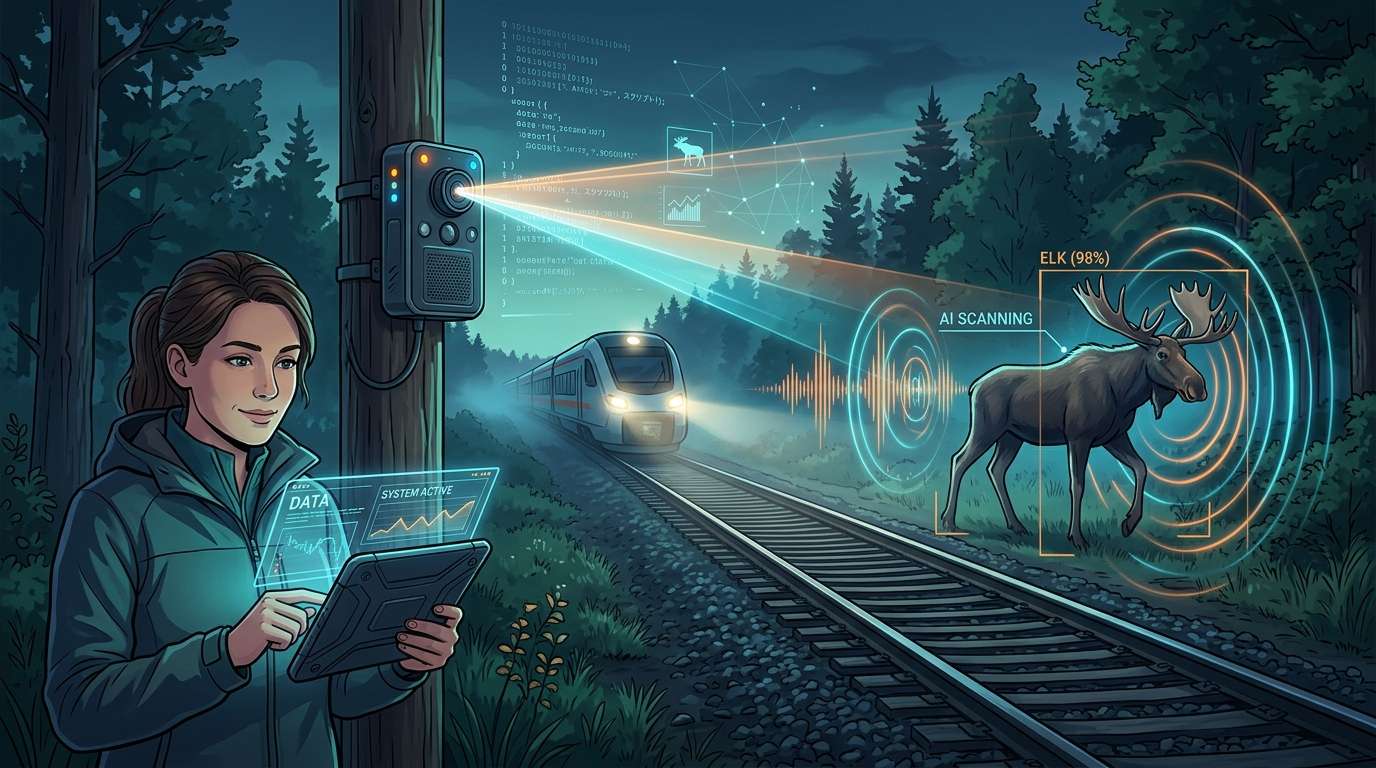
Swedish startup Flox Intelligence is rolling out AI-powered devices to keep wildlife away from railways, runways and roads. The system uses cameras to identify animal species and emits sounds tailored to the situation. Founder Sara Nozkova says about 150 units are operating across North America, Europe and Australia. The company was named a finalist in Startup Battlefield 200, the startup competition at TechCrunch Disrupt, held in San Francisco in October 2026.
The numbers behind wildlife collisions with transportation infrastructure
Collisions between wildlife and transportation infrastructure are far from rare. The U.S. Federal Aviation Administration estimates that wildlife strikes cost U.S. civil aviation an average of about $272 million a year from 1990 to 2025. France’s national railway, SNCF, says more than 8,000 trains a year are affected by animals straying onto the tracks, making them one of the top five causes of delays. In Brittany alone, animals collided with 120 trains in 2023, affecting 660 services and causing a total of more than 15,000 minutes of delays.
Founder Nozkova’s own introduction to the problem is striking. When she was 8, a train she was taking to Mumbai came to a grinding halt and took about eight hours to start moving again. She says the tail of a wild bison had become caught in a branch beside the tracks. She initially thought it was something peculiar to rural India, but later learned that it happens all over the world.
Sirens, lights, fences, birds of prey—and culling. Traditional approaches have largely focused on harassing animals to drive them away. Nozkova felt there were limits to that approach, leading her to conclude that “the answer isn’t a louder sound.”
Not louder sounds, but responses tailored to animals
Flox’s device starts when a motion sensor detects movement and wakes the unit. A camera then activates, and an AI model running on the device identifies the nearby animal species. The device then emits a sound suited to that species to scare it away.
The key is not to play the same sound every time. Animals become accustomed to repeated stimuli. Nozkova says the device learns from experience at each site and varies its response patterns. As with pigeons under streetlights that stop moving out of people’s way, habituation is the Achilles’ heel of deterrence-based approaches.
Another important feature is that the device uses edge AI, processing data on-site rather than in the cloud. It is designed for installation in places with unreliable connectivity, such as along railways, on farmland and in national parks. Making decisions and acting on the spot, without sending video elsewhere, suits the realities of outdoor operations.
The “blind spot” in autonomous systems that Nozkova observed
Nozkova has 13 years of experience in transportation and autonomous driving. What she came to realize was that machines perform well in environments shaped by humans, but become confused as soon as nature enters the picture. Unlike cities, factory lines and warehouses, where layouts are fixed and objects are known, nature is complex and constantly changing, she says.
She later joined the AI lab at KTH Royal Institute of Technology in Stockholm and began researching systems that adapt their responses to animal behavior and species. The initiative spun out of KTH in 2020 as Flox Intelligence.
Applications beyond transportation infrastructure
The company says about 150 devices are operating around airports, along roads and railways, in national parks and on farmland, in urban areas, at mines, and at substations and other critical infrastructure sites. Along railways and roads, they are mainly installed at fence ends and level crossings where routes used by wildlife intersect. The battery-powered devices can be mounted on poles or trees.
Software is another key part of the business. It lets users check device locations and conditions at each site, and can also be used for regulatory reporting and biodiversity monitoring. The devices therefore serve not only as deterrents but also as a sensor network that records animal movements in the field.
In the long term, the company plans to make its software available for outdoor machines such as trains, cars and drones. The vision is to move from fixed devices to the “eyes” of moving machines—a potential that extends beyond wildlife deterrence.
Could AI that understands nature become the next perception platform?
The business model combines device sales with annual software and AI fees starting in the second year after installation. Companies that put the software on vehicles such as trains enter into OEM partnerships and pay an annual fee. Railway rolling-stock manufacturer Alstom is one of its partners. Nozkova says the company expects revenue of about $1.5 million by the end of 2026.
Flox has raised about $5 million in pre-seed and seed funding. The seed round was led by Unconventional Ventures and Tilia Impact Ventures, with participation from GENIUS NY, Norrsken, Satgana and angel investors. The company is now launching a $10 million Series A, with plans to use the funds mainly to scale from about 150 units today to several thousand and expand its focus beyond wildlife.
There are competitors, too. Robin Radar’s Scarecrow uses species-specific warning calls to scare birds away and records their activity. iCHASE sells a system that detects birds using computer vision and drives them away with moving lasers. Nozkova points to the breadth of Flox’s system and the data it has collected in the field as its strengths. She describes it as “ground truth” on the conditions under which moose and grizzly bears move safely.
Nozkova says physical AI is moving out of factories and into the unruly, wildlife-filled outdoors. Trains, trucks, drones, tractors, robots and other machines operating outdoors will eventually need to understand nature, she argues, making “nature intelligence” the next layer of perception technology. While autonomous driving has advanced at recognizing people and vehicles, identifying wildlife and predicting its behavior remain relatively neglected areas. Could technology that fills this gap offer a way to reduce accidents without harming animals? Scaling to several thousand units will help provide the answer.

Comments