
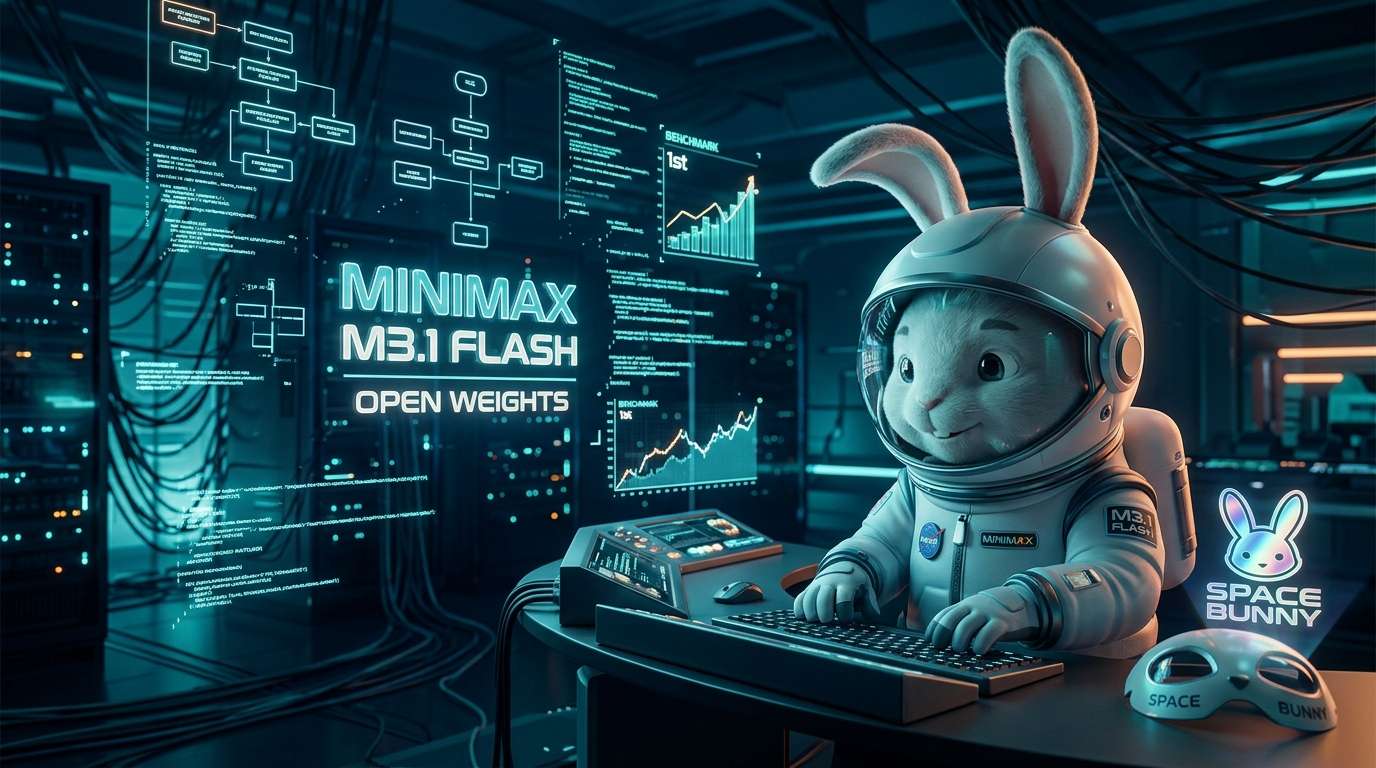
Chinese AI company MiniMax announced MiniMax M3.1 Flash, an LLM for coding and agent use, on October 19 (Japan time). The company said the previously anonymous model “Space Bunny,” which drew attention on global leaderboards, was an early version of M3.1 Flash, and said it plans to release the open weights (model weights) on October 23. API pricing is $0.15 per million input tokens and $0.60 per million output tokens.
The anonymous model turns out to be a coding-focused Flash model
A model suddenly appears on a leaderboard and stays near the top, with its name and developer undisclosed. It is an occasional phenomenon in the AI world, but the mystery of “Space Bunny” has already been solved. It is MiniMax’s M3.1 Flash. The company says the early version processed more than 200 trillion tokens cumulatively while its identity remained hidden, and took the top spot on global leaderboards.
M3.1 Flash is designed for coding and agent use, in which AI plans and carries out tasks on its own. It generates text and code, and is separate from the company’s video-generation AI, MiniMax H3. It is multimodal and can handle inputs beyond text, with a context window—the amount it can read at one time—of 1 million tokens. Another feature is the ability to adjust in stages how deeply it reasons before answering.
Run tests anonymously, gather feedback, and then put a name to the model. In today’s AI development race, this appears to be one way to collect data on how a model is used without preconceptions influencing users.
Pricing and speed target agent use
MiniMax is highlighting that M3.1 Flash costs one-third as much and runs three times faster than its existing top model, MiniMax M3. The company began offering M3 in June, and M3.1 Flash is positioned as a lighter, faster model beneath it. These multipliers, however, are best understood as claims made by the company.
API pricing is a flat $0.15 per million input tokens (about ¥24, at roughly ¥158 to the dollar) and $0.60 per million output tokens (about ¥95). Cached reads, which reuse content that has already been read, cost as little as $0.015 (about ¥2). The model is also available through MiniMax API, the M Plan pricing plan, and the MiniMax Code desktop app.
For agent use, a model’s intelligence is not the only factor that matters. Agents repeatedly reread the same instructions and materials as they work through tasks, so token use can snowball. Setting the cache price at one-tenth of the input price appears designed with that kind of use in mind.
Read benchmarks by area of strength
MiniMax published the performance figures in a comparison table. On Automation-Bench v1.0.6, which measures task automation capabilities, M3.1 Flash scored 62.2%, placing first among the seven models compared. “DeepSeek-V4.1-Flash-1017” came second at 60.5%, while “Claude Opus 5” scored 50.3%.
On DeepSWE v1.1, which measures code-fixing accuracy, M3.1 Flash scored 73.7%, short of the top score of 77.0% by DeepSeek-V4.1-Flash-1017. It also scored 91.0% on BabyVision, which tests image-based reasoning, when using tools—below Claude Opus 5’s 94.1%.
Taken together, the results show M3.1 Flash leading in task automation and ranking near the top in code fixes and visual reasoning, while other models take first place in those areas. Rather than summing it up as “the strongest overall,” it makes more sense to look at which metrics best match your intended use.
Key published figures
Automation-Bench v1.0.6: 62.2% (first among seven models compared); DeepSWE v1.1: 73.7% (top score: 77.0%); BabyVision with tool use: 91.0% (Claude Opus 5: 94.1%). All are comparison figures published by MiniMax.
Weights and licensing questions to watch when it launches
The open weights are scheduled for release on October 23. As of October 19, however, MiniMax had not specified where the weights would be available, the parameter count, or the applicable license. The parameter count is a basic piece of information for estimating whether the model can run on your own machine.
The previous model, M3, was released under the “MiniMax Community License.” It is free for noncommercial use, while commercial use is allowed for organizations with annual revenue of $20 million or less, provided they notify MiniMax and display “Built with MiniMax M3.” Whether the same conditions will apply to M3.1 Flash will need to be confirmed when it is released.
“Open weights” may sound like they are free to use without restriction, but conditions such as the scope of commercial use and attribution requirements vary by license. What you need to check will depend on whether you are trying the model personally or incorporating it into your company’s service.
The emphasis on low cost and speed could help broaden the reach of agent use. The surest course is to assess the model’s performance for your intended use alongside its license terms after examining the weights, due to be released in four days.









Comments