
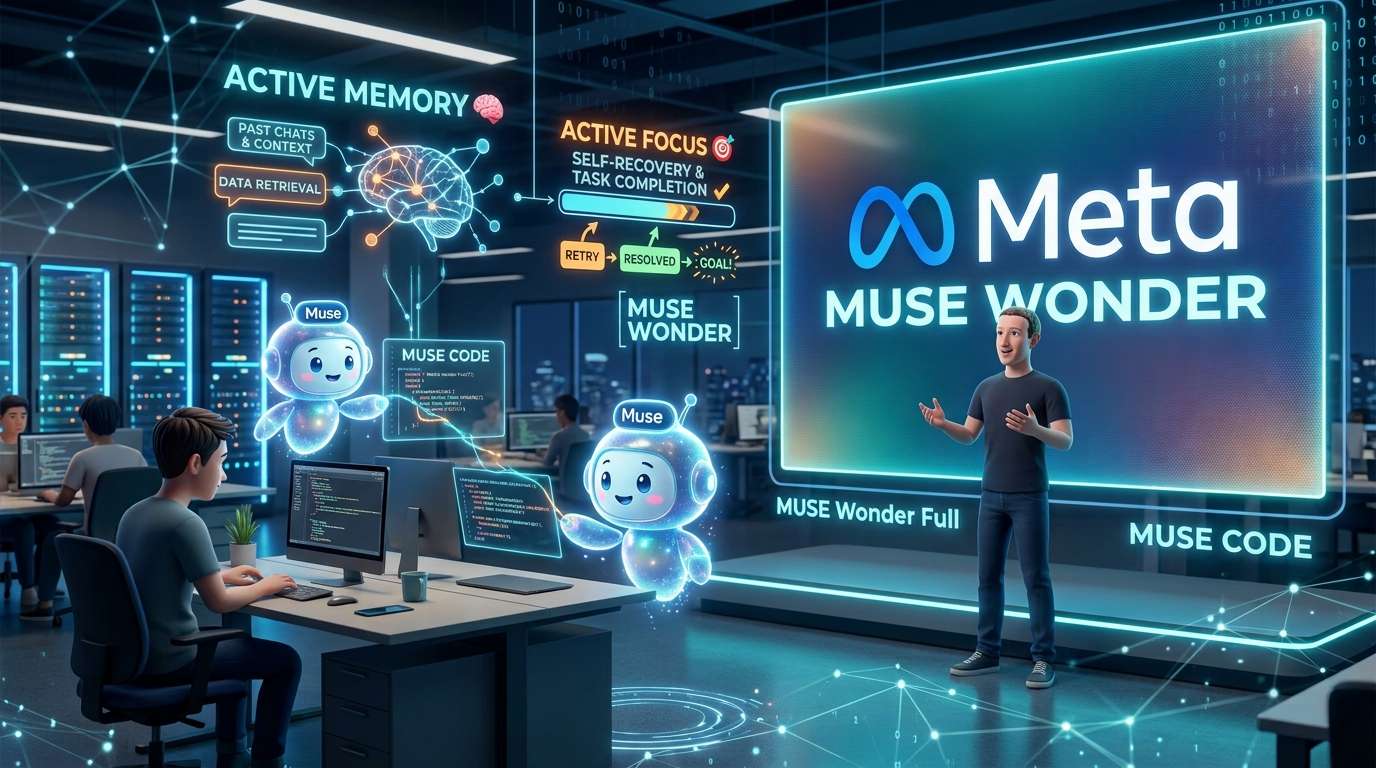
Meta announced its new AI model, “Muse Wonder,” and its more advanced version, “Muse Wonder Full,” on October 12, 2026 (local time). The company has begun offering them through an API for developers and its coding assistant, “Muse Code,” and plans to add them to its personal AI agent, “Muse,” soon. The models’ selling points are their ability to retain information across conversations and see difficult tasks through to completion. The announcement invites reflection on what really matters when you delegate work to AI.
AI Needs the Ability to Remember and See Things Through
The question “Is this AI smart?” is starting to feel inadequate. Sending an email, booking a trip, or searching for a property and following up with an inquiry: When you delegate tasks like these, whether the AI remembers what you discussed yesterday and keeps going when it hits a snag can matter more than the quality of a single answer. It’s a lot like assigning work to a new employee. Meta has put precisely those two abilities at the heart of its latest announcement.
Active Memory Remembers Across Conversations
Active Memory is the ability to retain information important to users across conversations and independently recall details relevant to a task. Meta says the models remember small habits and preferences, as well as casual exchanges from the past. Researchers say they focused on ensuring the AI would not forget important things even after days, weeks, or months.
Meta cited MemoryBench as a metric for measuring memory. In the company’s internal evaluations, Muse Wonder scored higher than competitors Claude Fable 5.1, Claude Opus 5.5, and GPT-6 Astra. It is worth noting that these figures come from internal evaluations.
Active Focus Helps the AI Recover When It Gets Stuck
The other feature, Active Focus, is the ability to keep working toward a goal even on difficult tasks. When it gets stuck, the AI tries another approach; when an error occurs, it recovers and completes the task. Meta says the system is designed to ask for clarification when needed and obtain the user’s approval before carrying out important actions.
The aim is to prevent the AI from losing sight of its objective and compounding mistakes while conducting complex research or developing large software projects. One way to think of it is as an employee who not only remembers and perseveres but also keeps their manager informed.









Comments