
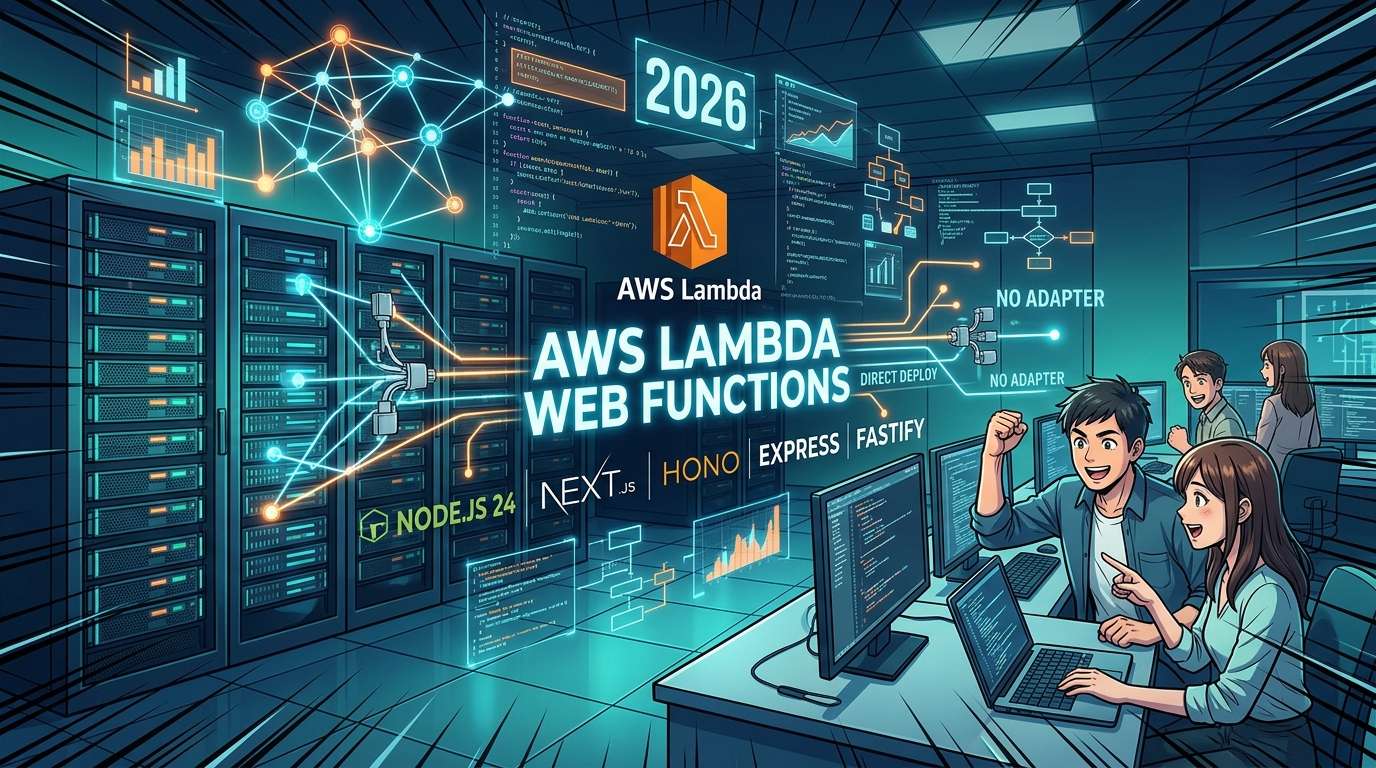
By October 20, 2026, Amazon Web Services (AWS) had announced “AWS Lambda Web Functions,” a new feature that lets developers deploy and run Node.js frameworks such as Next.js, Express, Hono and Fastify, along with their apps, directly on the serverless AWS Lambda platform. The feature is available in five regions, including Tokyo. Existing Lambda functions will now be called “Lambda Event Functions.”
The “HTTP barrier” that stood in Lambda’s way
Lambda is designed to run a function in response to an event and return a result. It could also receive HTTP requests and return responses, but function execution and HTTP handling were designed as separate processes. As a result, placing code for a web app built with Next.js or a similar framework inside a function wasn’t enough to make it work as-is.
The “AWS Lambda Functions Adapter” was created to bridge this gap by connecting a function to Lambda’s HTTP capabilities. It was much like a conversion adapter for plugging together connectors of different shapes. Developers had to build their setups around the adapter and adapt apps that ran locally to work with Lambda.
How Web Functions changes the deployment landscape
Web Functions are provided as “web functions,” with web server capabilities similar to Node.js built into Lambda’s execution environment. Node.js-compatible frameworks and apps can now be deployed and run directly inside a function.
What stands out is not so much the feature itself as the change in the developer experience. Serverless computing reduces operational overhead, but it has traditionally felt somewhat removed from the conventions of familiar web frameworks. Web Functions is a step toward closing that gap. Teams can run apps built with familiar tools like Express and Hono without having to think about managing servers. Plenty of development teams are likely to find that combination appealing.
Node.js 24 and execution environment specifications
The runtime is Node.js 24. The execution environment’s main specifications are as follows.
Specifications
・Runtime: Node.js 24
・Memory: 2 GB per execution environment
・Default heap size: 1,024 MB
・Concurrent requests: Up to 128 per execution environment
・Timeout: 30 seconds by default (configurable from 3 seconds to 15 minutes)
・Available regions: Tokyo; US East (N. Virginia); US East (Ohio); US West (Oregon); Europe (Ireland)
The ability to handle up to 128 concurrent requests in a single execution environment is particularly notable. A web app can generate multiple requests even for a single page view, so the number of concurrent requests each environment can handle is an important factor in planning its architecture. The timeout can also be extended to 15 minutes, leaving room for apps that include time-consuming tasks.
More factors to consider when choosing a hosting provider
Running Node.js apps such as Next.js on dedicated hosting services like Vercel has become an established option. AWS has now brought another option to the table, leveraging its massive infrastructure through Lambda, leading some to see this as the beginning of a competitive clash.
But the arrival of a new feature alone doesn’t determine which option is better. The best choice depends on what matters most, whether that’s cost, operational workload or compatibility with an AWS environment already in use. For companies that have already built systems on AWS, the ability to run web apps on the same platform is a benefit worth considering. Other teams may prioritize deployment simplicity or developer-focused features.
Having more options is a welcome development for developers. What kind of workloads will our apps handle, and where do we want to spend our money? Web Functions looks like a new feature worth trying as a prompt to revisit those questions.









Comments