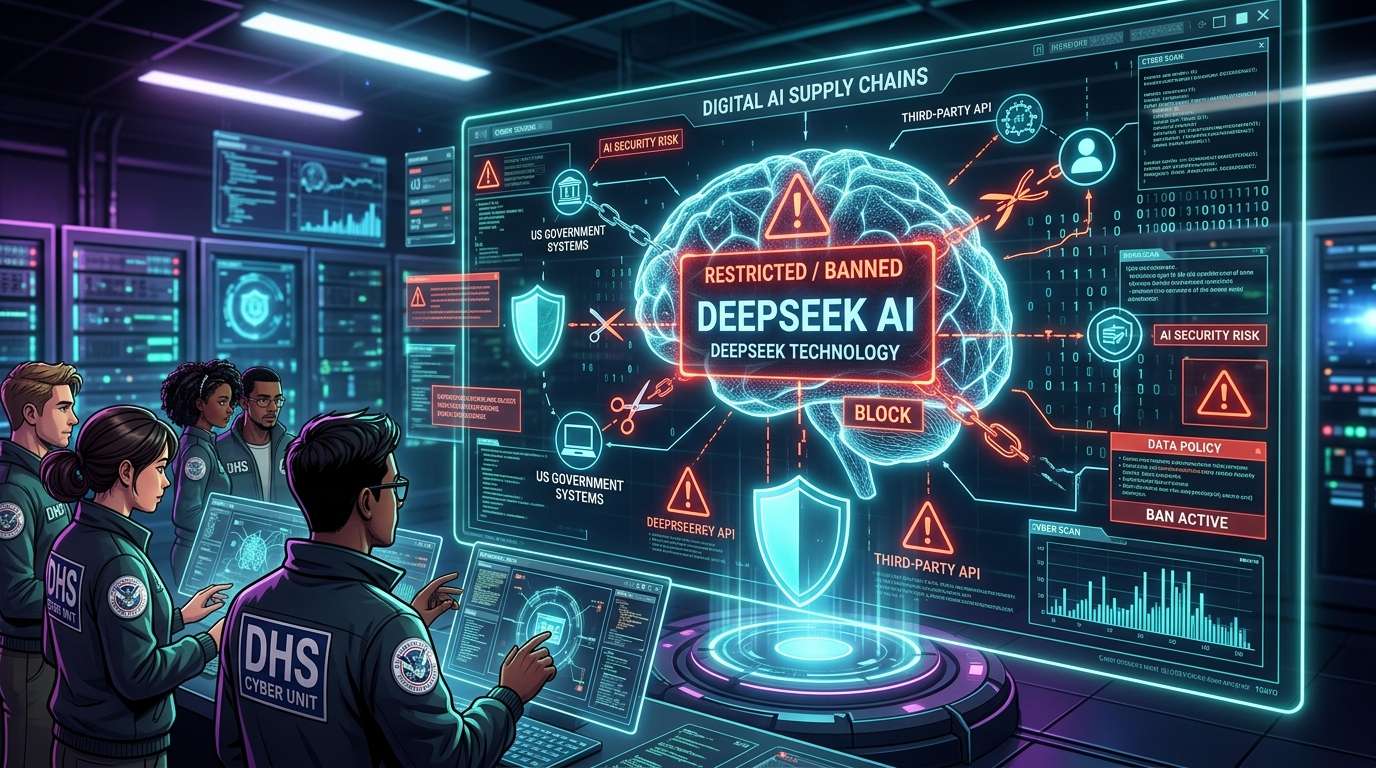
The U.S. Department of Homeland Security (DHS) has ordered federal civilian agencies to stop making new purchases of products and services developed by Chinese AI company DeepSeek and remove them from government IT systems. The order covers not only DeepSeek’s own services but also third-party products and services built using its technology. Agencies can apply for exemptions. The stated reason is national security concerns tied to the company’s operations in China.
The restrictions extend beyond DeepSeek by name
What stands out about the order is its broad scope. It goes beyond simply avoiding DeepSeek’s chat service or app: procurement and use of other companies’ products and services built on its technology are also subject to review.
In other words, even if a service appears under a different name, it could be treated the same way if DeepSeek technology is running behind the scenes. It is a bit like being told to check not just a food package’s brand but also its list of ingredients.
In procurement, asking vendors, “Which models do you use?” could become a required step alongside comparing price and features. It is not unusual for AI products to incorporate models from other companies. A closer look deep into the supply chain is likely to be more important than ever.
Agencies can still apply for exemptions. That means the order is not a blanket ban, and there is room for case-by-case decisions. However, the circumstances under which an exemption may be granted will need to be understood as the policy is implemented.
The focus is on where the data goes
The concern DHS cited was DeepSeek’s handling of user data. The order reflects fears that sensitive information entered by U.S. government users could be accessed by Chinese authorities under Chinese law.
The key point here is that this is not a finding that a data leak has occurred, but rather the government’s assessment of the risk. Even so, it is clear that AI services are no longer being evaluated solely on how capable or inexpensive they are.
Generative AI tools receive a wide range of inputs, including drafts and summaries of documents and responses to inquiries. Where is that input stored, and which country’s legal system applies to it? In public procurement, these questions are beginning to carry as much weight as performance.
This is not just an issue for government agencies. For companies whose employees feed internal documents or customer information into AI tools, checking where a service operates and which laws apply should also become a familiar precaution.
From government restrictions to U.S.-China tech competition
The United States has already restricted the use of DeepSeek within government. A law enacted in December 2025 covered use in national security systems at intelligence agencies. The latest order extends the restrictions to federal civilian agencies and applies to both new purchases and existing systems.
The backdrop is the AI competition between the United States and China. DeepSeek is challenging U.S. companies such as OpenAI and Meta with low-cost open-weight models. “Open-weight” refers to a format in which the data that make up a trained model are made public, allowing users to run it in their own environments. Because these models are easy for anyone to incorporate, they can spread quickly through third-party products. The broad scope of the latest order is likely related to this characteristic.
At a regular press briefing on Tuesday, Chinese Foreign Ministry spokesperson Mao Ning said China opposes an expansive interpretation of the concept of national security and the politicization of technology and trade issues. She also said China would resolutely safeguard the legitimate rights and interests of Chinese companies.
There is also movement on China’s side. Bloomberg reported last week that China is considering export controls on 23 AI-related technologies, including chip design and some advanced AI models. The measures are said to be aimed at addressing security and misuse risks.
DeepSeek has remained in the spotlight of governments and regulators around the world since releasing its R1 reasoning model in January 2025, an announcement that triggered a sharp drop in Nvidia shares. The latest order is part of that broader trend.
I see this shift as broadening how AI is evaluated—from “Which model is more powerful?” to “Which side’s technology ecosystem does it belong to?” As model performance becomes more similar, factors beyond performance, such as where data goes and which legal jurisdiction applies, will increasingly influence decisions. A time when this matters to companies around the world, including those in Japan, is drawing near.




Comments