
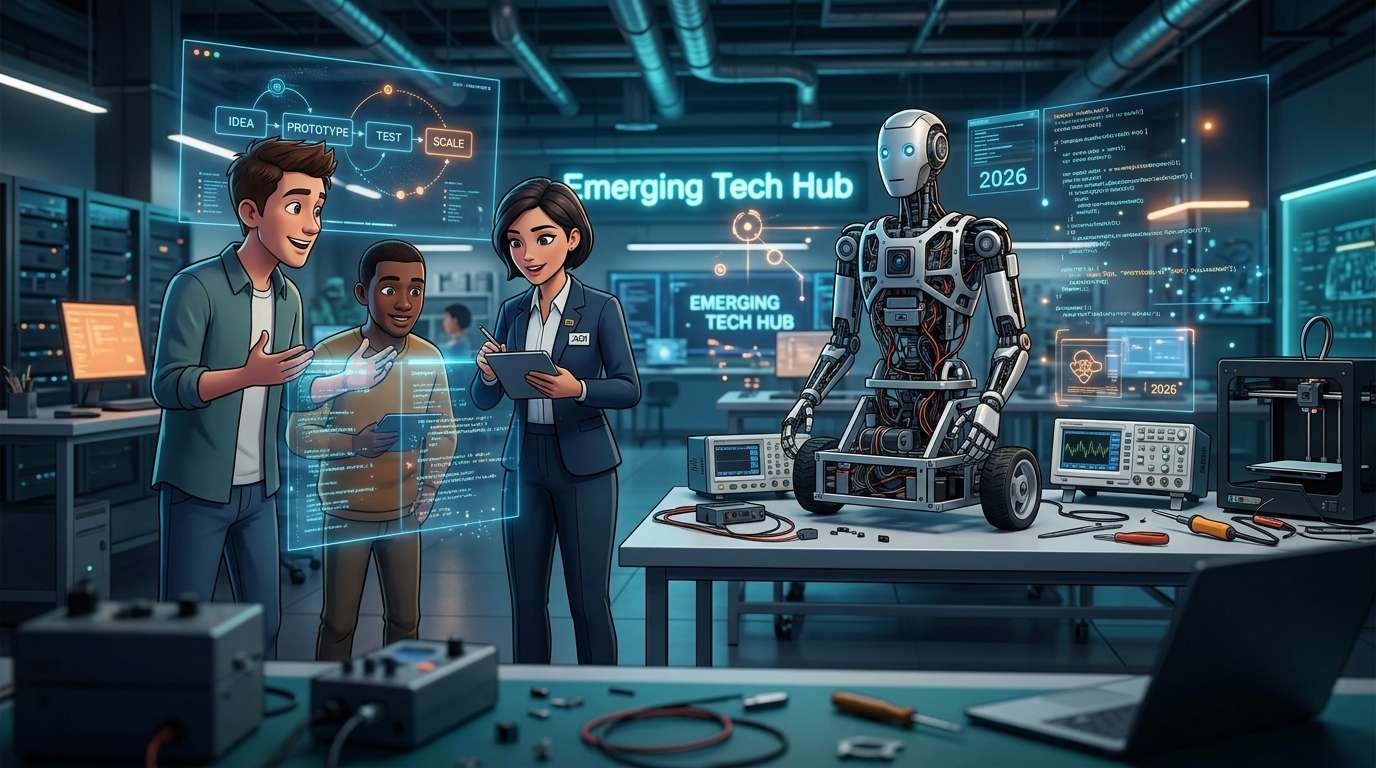
Semiconductor giant Analog Devices (ADI) is preparing an “Emerging Tech Hub” to support startups and established companies in the robotics sector. The initiative is designed to provide joint development with ADI engineers, prototyping and testing facilities, and expertise in manufacturing and procurement. Applications from outside companies are expected to open by the end of 2026.
The gap between getting a prototype to work and keeping a product working
New capabilities in robotics, from humanoids to autonomous mobile robots, are emerging at a remarkable pace. But the challenge ADI identifies is not simply keeping up with the technology; it is turning a successful prototype into a commercial product that can be manufactured and deployed at scale.
Startups are adept at adopting next-generation technologies such as sensing, control and AI. But commercialization requires different expertise in areas such as electronics, systems integration, validation and manufacturing. This can place a sudden burden on small teams.
A prototype serves its purpose if it demonstrates that a technology works. But once it becomes a product, the entire system must operate reliably even as the conditions in which it is used change. ADI views this process in four stages: “idea,” “prototype,” “validation” and “scale.” The first stages involve turning a concept into something tangible and demonstrating it. Validation involves testing the assembled system, identifying problems and refining the design. At the scale stage, companies must also secure components, coordinate production and establish processes that maintain quality as volumes grow.
Another key point is that a robot’s actions depend on multiple functions working together. A white paper on physical AI that ADI contributed to outlines the need for sensing, signal conversion, perception, inference, control, computing and validation to work as an integrated whole. Even if AI makes the right decision, that decision cannot become an action without accurate sensor data, well-timed control signals and enough power to drive the actuators. In other words, the system must be designed to include not just the brain, but also the nerves and muscles.
One point of contact, from technical advice to production readiness
The Emerging Tech Hub is a robotics-focused initiative taking shape within ADI’s Analog Garage. It aims to connect startups and established robotics companies with ADI technical teams working on new and emerging technologies. Cameron Billone, ADI’s senior product technology manager, describes the approach as “co-development.”
When a company seeks advice, the first step is to assess its current level of technical maturity and its goals, and determine how they align with the hub’s mission. The next step is to decide what form of collaboration would be appropriate. A company with a mature development program may need a specific semiconductor component, while another may need help finding an ADI expert with the right knowledge for a particular challenge. Early-stage startups, meanwhile, may benefit from broader guidance, such as refining their architecture or identifying future development challenges.
The support has three pillars.
### Three Areas of Support
The first is technical expertise spanning robotics, control, edge AI, power and systems integration. The second is development resources, including research facilities, prototyping tools, reference designs, testing and validation capabilities, and on-site technical support. The third is procurement guidance and industry connections for companies preparing to ramp up production.
Billone said ADI has hired robotics specialists from across the industry. One example he cited is ADI’s GMSL technology, which is used for camera connectivity. The idea is not just to help companies select components, but also to guide them on how the technology fits into the robot as a whole.
This may sound like a relatively remote topic to general readers. But as robots become more common in warehouses, factories and cities, the depth of this behind-the-scenes design support will affect how reliably products perform. Behind the flashy demo videos, mechanisms are taking shape to help shorten the path to mass production.
The terms of collaboration must preserve startups’ independence
Working with a large company offers access to expertise and facilities that are difficult to build independently. At the same time, startups may worry that the relationship could undermine their development speed or control over their technology. Billone acknowledged that some startups hesitate to collaborate because they are concerned about what a relationship with a large company could mean for their business.
Still, Billone sees opportunities when both sides are clear about their intentions. ADI is interested in expanding the range of robotic applications that use its semiconductors. Startups, in turn, can gain expertise and resources that would be difficult to develop on their own. The clearer each side is about what it wants to accomplish, the better the relationship is likely to work.
Emerging Tech Hub follows the same model, with ADI emphasizing a collaborative, flexible approach tailored to startups. Its principles also include allowing startups to retain their intellectual property. The program is designed to provide support without requiring them to give up ownership of their technology.
The topic will also be discussed at the “Robotics Startup Boot Camp Part 2” session at RoboBusiness on October 20, 2026. Emerging Tech Hub head Colm Prendergast is scheduled to join representatives from MassRobotics and WiBotic to discuss how to approach proofs of concept and pilots, how companies evaluate potential partners, and how to balance startups’ agility with the processes of large enterprises.
The next challenge facing the robotics industry
The robotics industry is entering a stage where success depends not only on building working prototypes, but also on manufacturing them without compromising quality and delivering them to the field. Emerging Tech Hub is being prepared as an initiative to bridge that gap.
Participation by outside companies remains limited, and applications are expected to open by the end of 2026. Which companies will take part and what products will emerge once applications open? Whether the program can narrow the gap between prototyping and mass production should become clear through the partnerships that take shape over time.




Comments