
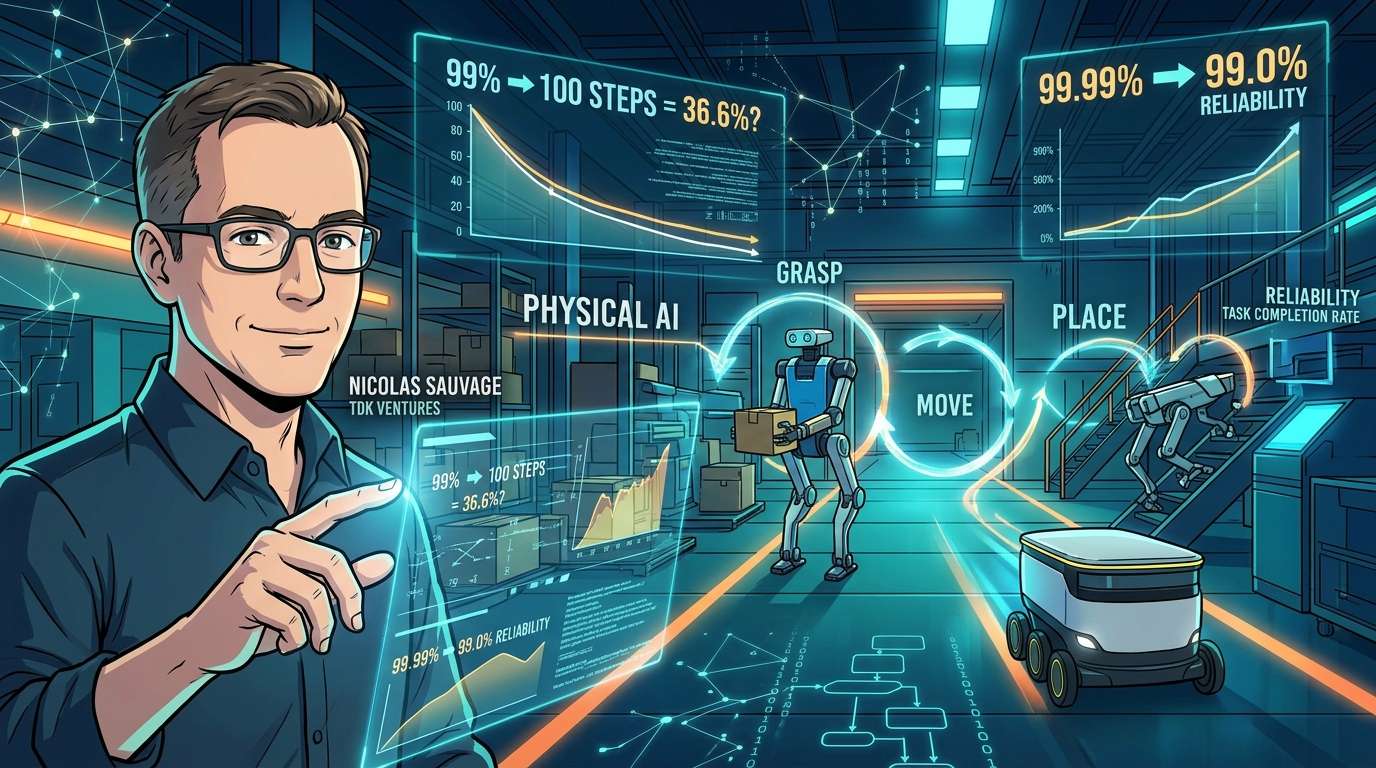
A robot picks up an object, carries it and sets it down. If those actions succeed 99% of the time, you might think it is close to being practical. But in a job involving 100 consecutive actions, the probability of getting every one right on the first try is only about 36.6%. Nicolas Sauvage, founder and president of TDK Ventures, argues that the challenge for physical AI should be reframed not simply as “manual dexterity” but as the reliability to complete an entire process without human assistance.
The pitfall behind the 99% figure
Watching a robot demo, it is easy to think, “It’s already as good as a human.” But the real question is not whether it succeeds once. It is whether it can repeat the task hundreds of times even when an object is slightly out of place, the grip changes, parts wear down or unexpected problems arise.
Sauvage offers a simple, easy-to-understand calculation. In a job consisting of 100 actions performed in sequence, if each action has a 99% success rate, the probability of getting them all right on the first try is about 36.6%. At 99.9%, that rises to about 90.5%, and at 99.99%, to about 99.0%. This example is based on the simplifying assumptions that each action has the same success rate and that the actions are independent.
In other words, a robot with a 99% success rate does not mean 99% automation. The number of nines determines whether a person needs to supervise the robot or whether it can be trusted to work on its own, he suggests.
Dexterity lies in the entire process, not just the hands
Robot dexterity is often framed as a hardware race over the number of fingers or joints. But, as Sauvage points out, customers are not buying degrees of freedom; they are buying useful work.
Completing a job requires a continuous closed loop connecting vision, position, contact, force, pressure, grasping, movement and adjustment. It needs to be viewed as a “system” that also includes power, safety, flexibility and recovery from failure.
Touch can provide useful information about whether an object is starting to slip, contact is unstable, too much force is being applied or a part has settled into the correct position. However, not every task requires touch; in some cases, visual and motion data are enough. What matters is not piling on every possible sense, but providing enough information for the job at hand.
Robots that can recover from mistakes are closer to real-world deployment
A major part of dexterity is the ability to recover. When an object starts to slip from a robot’s grasp, whether the initial grip was perfect is not the point. The question is whether the robot can quickly detect and correct the slip before a minor error turns into a failure of the entire task.
Failures found in the field may point to problems with software, sensors or control, or they may call for a redesign of the robot itself. Changing the shape of a hand changes its movements, sensor characteristics and adjustments, so data collected with one design cannot necessarily be applied as-is to another. That is why Sauvage considers field deployment part of development.
Slips, inadequate grips, wear and failed recovery all generate data that can feed into improvements to software, simulation, sensors, control and hardware. The idea is that each turn of this cycle makes the next deployment more reliable and less costly. A technical breakthrough is only the starting point of the journey; the surrounding learning system multiplies its impact. Sauvage argues that adding more “nines” takes repeated deployment, learning and improvement.
Choose a form suited to the job, rather than a humanoid one
The idea that a robot is better the more closely it resembles a human also warrants caution. The starting point should be the task, working backward from there to determine the environment, form and systems required. The same logic applies to dexterity: the most humanlike hand is not necessarily the best. The goal, the author argues, is not maximum dexterity but “sufficient dexterity” to reliably perform valuable work.
One example cited is Agility Robotics’ bipedal robot, Digit. Designed for logistics and industrial applications, it can be directly connected to task-specific tools instead of being equipped with a five-fingered hand. Its design prioritizes the form and dexterity required for the job over human likeness.
ANYbotics’ quadrupedal robots inspect hazardous areas while navigating stairs and uneven terrain at industrial facilities, reducing the need to expose people to danger. In one reported deployment, the robots conducted more than 33,000 inspections across 450 inspection points.
Starship Technologies’ delivery robots are designed to travel on sidewalks, making compact wheeled models more suitable than legged ones. The company reports that this task-specific approach has enabled more than 10 million autonomous deliveries.
The three look completely different, but they share a common principle: the right design is the one suited to the work and able to operate repeatedly in that environment. Sauvage says his perspective as an investor has shifted through investments in Agility, ANYbotics and Starship. The question is no longer which robot looks most human, but which is a complete system that can meet customers’ reliability requirements.
From demo success rates to task completion rates
So how should we measure progress in physical AI? According to Sauvage, the success rate of a one-off action shown in a demo tells us very little about whether a robot can work autonomously on the job.
What matters is the share of processes completed without human assistance. How often can a robot recover from a problem without help? How does its performance change when the objects, lighting, positions, wear or surrounding environment vary?
There are also less glamorous questions that become more important as deployments scale. What breaks first after repeated use? How quickly can the robot get back to work after diagnosis and repair? What are the speed, uptime and cost per job completed successfully? The argument is that these metrics are a better measure of dexterity than a one-off demonstration.
Creating value does not require the most humanlike hand, the most joints or the broadest range of skills. What matters is the right combination of physical form, sensing, control and recovery capabilities to reliably perform valuable work in the environment where it will actually operate. Sauvage believes that is where the next contest over robot dexterity will be decided.


Comments