
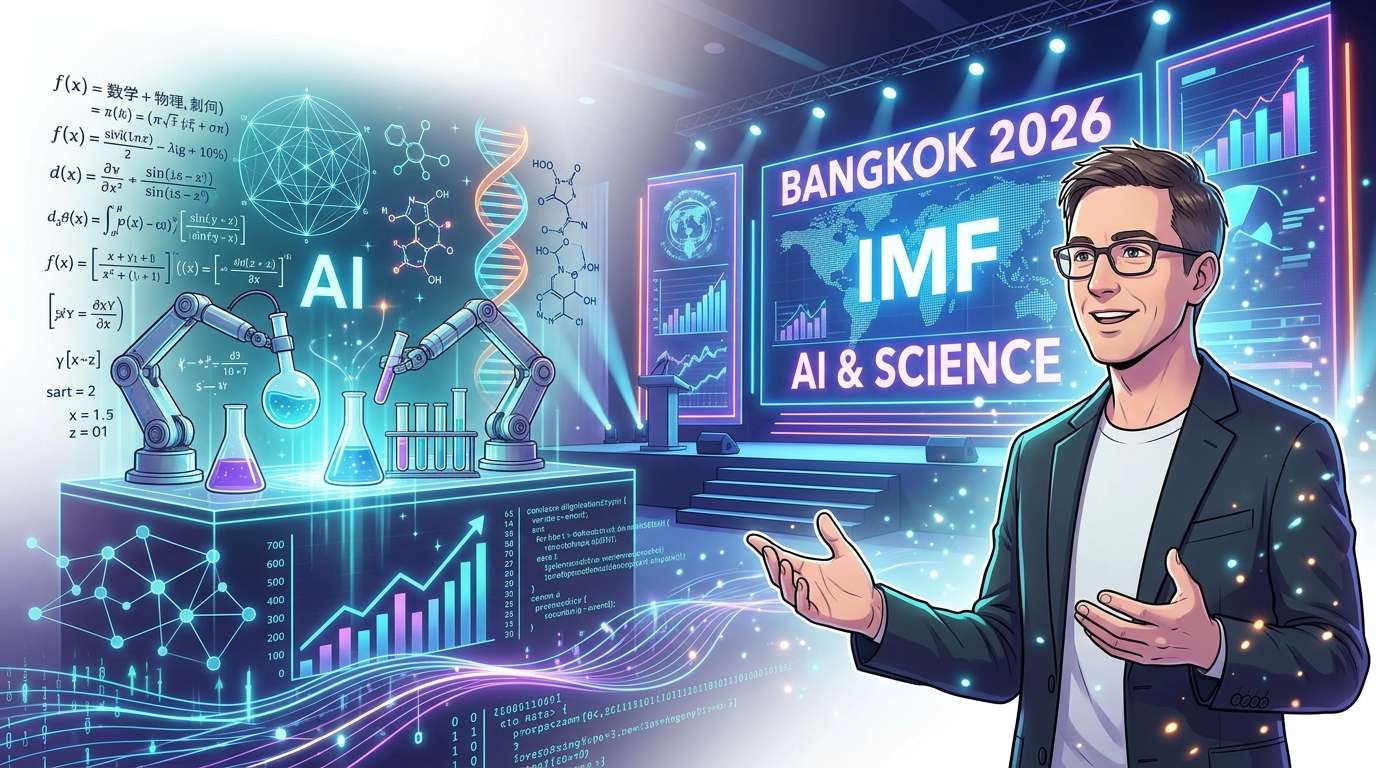
On October 17, 2026, Anthropic co-founder Jack Clark delivered the Per Jacobsson Lecture at an IMF meeting in Bangkok, Thailand. He urged economists and policymakers to prepare for rapid change, saying AI is beginning to make advances at the scientific frontier in fields such as mathematics, physics and drug discovery. Clark said he believes “the singularity has already begun,” and discussed both the investment needed to share its benefits and the need to sometimes hold back.
From AI that writes text to AI that enters the lab
When people hear “generative AI,” many probably think of tools that create text or images. Clark’s lecture looked beyond that. The setting was scientific research: he believes AI is entering a phase in which it takes on unsolved questions alongside human researchers.
Clark invoked the concept of the “technological singularity,” predicted in 1993 by science fiction writer Vernor Vinge. If intelligence surpassing humans drives progress, progress itself will produce even smarter beings in ever shorter periods. That is the state the concept describes. Clark said that by 2026, persuasive evidence of its beginnings had accumulated. He acknowledged that “the arrival of the singularity” is his own view and that some details remain open to debate. Still, bringing the term to the International Monetary Fund (IMF) is itself a sign that discussion of AI is spreading beyond the technology industry.
Will AI become researchers’ “hands”?
The lecture cited examples from several fields. In mathematics, AI has been used to propose solutions to long-unsolved problems, and in some cases AI supplied the key insight. In biology, AI is being used to design viruses and identify drug candidates; Clark said drugs designed with substantial AI involvement have already entered clinical trials. In robotics, AI is beginning to operate experimental equipment autonomously and remotely, advancing the automation of experiments in areas such as battery and fuel-cell development.
Clark emphasized that these are not separate technologies. The same single frontier model is used for many applications. In his view, systems such as Claude, ChatGPT and Gemini have become capable of carrying out cutting-edge work across multiple scientific fields.
He also suggested that changes first seen in software development will spread to science and robotics. According to Clark, the amount of code written by researchers at Anthropic has reached about 10 times the amount written during the company’s first four years. At the same time, better coding capabilities are also boosting the ability to carry out cyberattacks, setting off a contest between defenders and attackers. Benefits and risks are emerging together, inseparably. Clark called this “a preview of what is to come.”
Scores trace a steep curve, while physicists share their experience
To illustrate the rise in capabilities, Clark cited two tests. On “Humanity’s Last Exam,” a test of challenging questions, the top score was 8% when it was released in January 2025, but had reached 67.7% by the week of the lecture. On “FrontierMath,” a set of problems created by mathematicians, he said scores rose from 2% at its release in November 2024 to 94%. These are the figures Clark presented in his lecture.
One striking anecdote involved “TheoPhysEval,” a new evaluation in theoretical physics. When AI was given 50 unpublished questions assembled by physicists around the world, it not only scored highly but also argued that the experts’ model answers were wrong. On review, several cases turned up subtle errors deep in the experts’ calculations. The AI’s score rose with each correction, eventually reaching 98% (49 out of 50), according to a comment by Suvrat Raju, a contributor to the paper.
Clark compared the episode to a scene in a movie where a student proves their ability to a mentor: the moment the teacher becomes the student. He said the story matters because frontier science is a test of “creativity.” If AI can creatively solve problems in science, that ability could extend across many fields, including AI research itself, he said.
Could growth change in a world with 100 times as many researchers?
Clark’s argument becomes more ambitious when he turns to economic growth. Over the past half-century, the number of researchers has increased in many countries, yet research productivity has declined. This is the problem often described as “good ideas are getting harder to find.” AI could change the picture if it can serve as a “virtual researcher.” Clark posed the question using his own experience as an example: What if hundreds or thousands of copies of him could work simultaneously, when it took about 40 years for him to develop?
Training human researchers takes 10 to 15 years and costs millions of dollars. With AI, any number of virtual researchers could be assembled instantly, given sufficient computing resources. Clark said this would make each human scientist more important, as they take on the role of supervising hundreds or thousands of virtual specialists.
In a simulation by Anthropic that Clark cited, U.S. GDP could reach $44 trillion by 2030 if models autonomously handle a broad range of tasks and spread rapidly through the economy. Clark acknowledged that the figure “sounds far-fetched,” but described it as a consequence that follows if the technology continues to advance. This is a scenario-based estimate, not a definitive forecast.
More discoveries mean little without the capacity to put them to use
Clark said experimental facilities and robots are the next foundations to build after computing resources. Over the past decade, he said, he urged governments around the world to develop power infrastructure and data centers, but few policymakers listened. Data center capacity is now growing in prominence in the United States, China and the Middle East, and supply chain constraints are pushing prices higher, he said.
The next stage is an expansion into the physical world. UNESCO estimates there are about 10 million scientists worldwide. Clark said even that number is not matched by enough research supervisors, materials science analysis facilities, biology labs to test new drugs, or large experimental apparatus in space and on Earth. What happens when virtual scientists number 1 billion or 10 billion? Clark’s question is a concrete one.
One warning worth noting is the prospect of a “discovery bottleneck.” A flood of drug candidates would mean little if only a handful could be tested. Clark urged policymakers to build systems that speed the movement of results from labs to clinical trials, factories and the field. Even if AI accelerates “ideas,” verification and implementation will remain bound by the pace of human society—and the bottleneck will simply move further down the line.
Clark applied this dynamic to the position of different countries. Developed nations with strong scientific infrastructure can boost researchers’ productivity. Developing countries that supply raw materials and other resources have an opportunity to “leapfrog” by building testing facilities, nurturing scientific communities and increasing their value in supply chains, he said.
What to delegate—and what to understand
The second half of the talk shifted its focus from expectations to choices. The fact that AI can do science does not mean it should be entrusted with everything. Clark first pointed to biological research, saying it requires the strictest human oversight and transparency. The same applies to AI research itself: how much oversight to place on AI-led research is a question that institutes such as Anthropic will have to decide. Such research could accelerate progress, but it also risks losing control, so it should proceed cautiously, he said. Rules will also be needed.
Clark also recounted an encounter with a physics student at a university in Tokyo. As AI begins to carry out many experiments, how should people decide which experiments to do themselves and which to leave to AI? Clark said he did not have the answer, but framed it as a question that each field must answer for itself.
The second choice is how far to understand AI’s results. In mathematics, AI-generated findings are already becoming so original that humans must work to decipher them. And within a few years, AI may be inventing new experimental equipment tailored to how AI itself works. Should humans understand that equipment? Clark said this, too, is a choice we must make.
Separating what we can do from what we should do
Clark recalled that as a teenager, he feared humanity was headed for collapse as population growth, climate change and resource waste converged. Since then, he has seen solar panels become cheaper faster than expected, advances in understanding the human body lead to treatments for diseases, AI begin to decode animal vocalizations, and rockets land and be reused. These experiences convinced him that technology can change the outlook, he said. That, Clark said, is also why he works on AI.
At the same time, AI carries inherent risks. Clark called for exceptional, robust rules for the technology and the companies developing it, as well as “restraint”—one of humanity’s most difficult qualities. His position is that infrastructure should be built while development of the technology itself is paced and pursued carefully.
In closing, Clark cited a passage from Carl Sagan’s “Pale Blue Dot.” The gist was that humanity, when it eventually reaches other stars, will be “much like us, but with more of our strengths and fewer of our weaknesses.” Sagan envisioned that growth taking hundreds of thousands of years; Clark said humanity would have to accomplish it “in a few years.” The challenge is whether we can strengthen both our ability to accelerate research and our judgment about when to pause.





Comments