
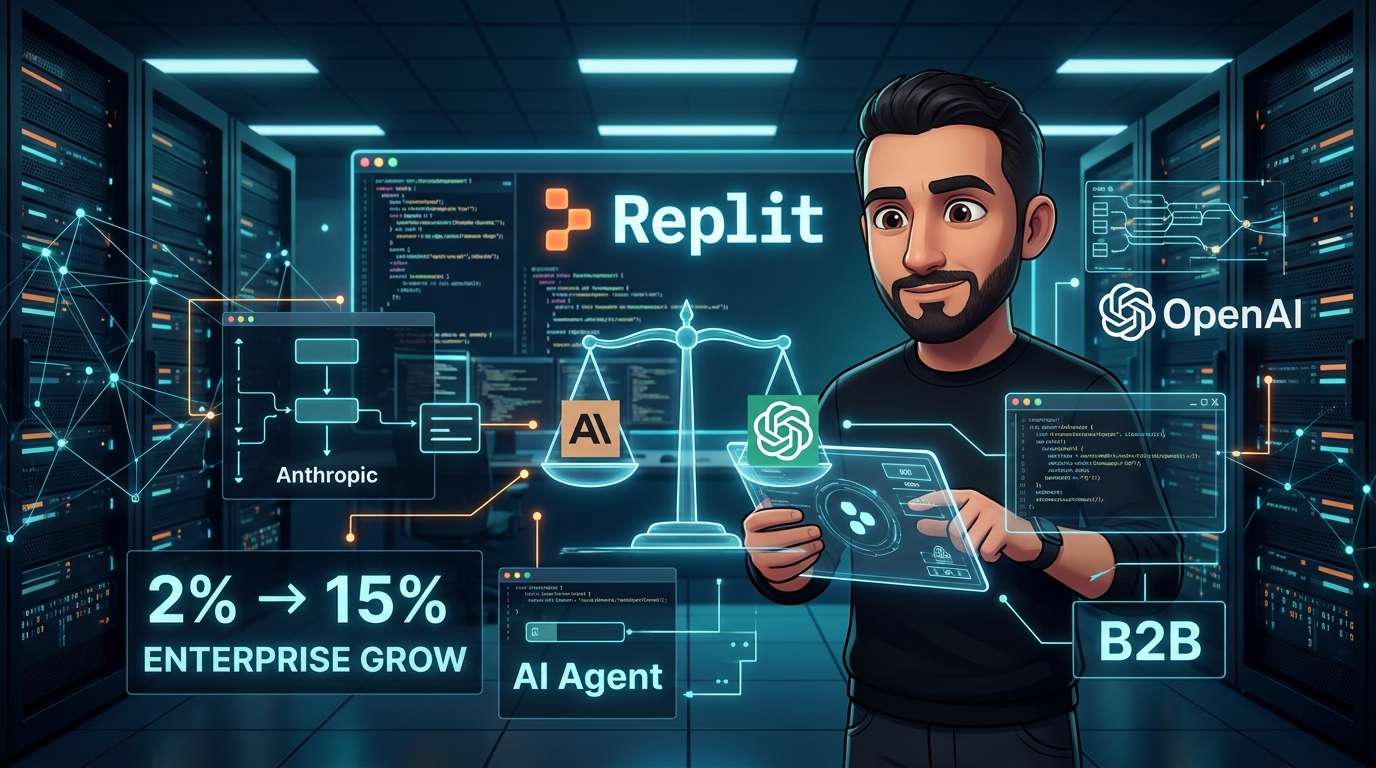
Amjad Masad, co-founder and CEO of AI coding service Replit, said at TechCrunch Disrupt in the United States that the company had stopped working with Anthropic. He cited costs, the partnership and performance as reasons. However, one person familiar with the companies’ partnership said it was “still ongoing,” contradicting Masad’s account.
Why the CEO Says Replit “Switched”
Replit is a cloud-based platform that lets users build and publish apps entirely in a browser. It has been popular with startup founders and developers. The service has run on Anthropic’s Claude models, and the partnership has reportedly helped drive revenue growth.
Masad said several factors contributed to the decision: cost, the fit with Anthropic as a partner, and performance. Replit announced a partnership with OpenAI in August, but no information had emerged indicating that its relationship with Anthropic had ended.
“I think ChatGPT is better now,” he said. He explained that Replit has its own internal benchmarks for measuring model performance and also publishes benchmarks publicly. He added that “Sol and Astra” consistently perform well when building apps from scratch through vibe coding, a method of creating apps by giving instructions to AI.
Choosing an AI Model Isn’t Just About the Performance Scores
What stands out in these remarks is that Masad cited cost and the partnership alongside performance as equally important factors. For companies running AI services, models are increasingly becoming like electricity or water. Costs accumulate with use, so even a small difference in per-unit pricing can affect profit margins.
Even with strong benchmark scores, contract terms, supply stability and opportunities for joint business development can all become reasons to switch. Conversely, when models are closely matched in performance, cost and the business relationship may increasingly tip the balance.
For users, this means the technology behind a service they use regularly could suddenly change. When choosing an AI service, we may be entering an era in which it is worth paying attention not just to the brand name on the surface, but also to which model is running behind the scenes.
Conflicting Accounts of the End of the Collaboration and Actual Usage
The picture is not so simple, however. One person familiar with the partnership said, on condition of anonymity, that it was “still ongoing”—a direct contradiction of Masad’s account.
Replit’s official website, blog and social media also contain evidence that it was using Anthropic products until very recently. A blog post from late September described Anthropic’s Claude Fable 5 and Claude Fable 5.1 as models running in production for Replit Agent. Around the same time, a Replit product employee reportedly posted on X that the company was using Anthropic’s flagship model, Opus 5.5, and praised its capabilities.
In light of this history, how people interpret the phrase “stopped working together” depends on whether it refers to a contract that has already ended or a strategic shift that is still to come. What can be said with certainty at this point is that the CEO made that statement publicly and that people familiar with the partnership have offered a different view. TechCrunch says it has asked Replit for further clarification and will update the article if it receives a response.
Enterprise Sales Rise From 2% to 15%
At the same event, Masad also discussed the makeup of Replit’s growth. He said the company was not yet disclosing its annual recurring revenue (ARR), but that revenue from enterprise contracts had risen from about 2% last year to about 15% this year. He also said that more than 50% of revenue came from business-to-business (B2B) sales.
The picture is of a service popular with individual developers and founders beginning to capture demand from large companies. Enterprise contracts tend to put a premium on predictable pricing and reliable supply in addition to performance, which could also influence decisions about which models to use.
AI Agents Need a “Place to Live”
Masad also discussed AI safety measures, comparing AI agents’ needs to those of human workers: just as people need an environment with offices, air conditioning and computers, AI agents need a “place to live.” Agents, in this context, are AI systems that carry out tasks on behalf of people.
The requirements he listed included systems for running multiple processes together, recovering from errors, safety and security, an environment isolated from outside systems (a sandbox), networking, and identity verification and access management. He said AI can be deployed safely only when these elements are in place.
While model switching is drawing attention, putting AI to work also makes the operational infrastructure around the model just as important as the choice of model itself. Masad’s remarks offer a glimpse of where Replit sees its own strengths.









Comments