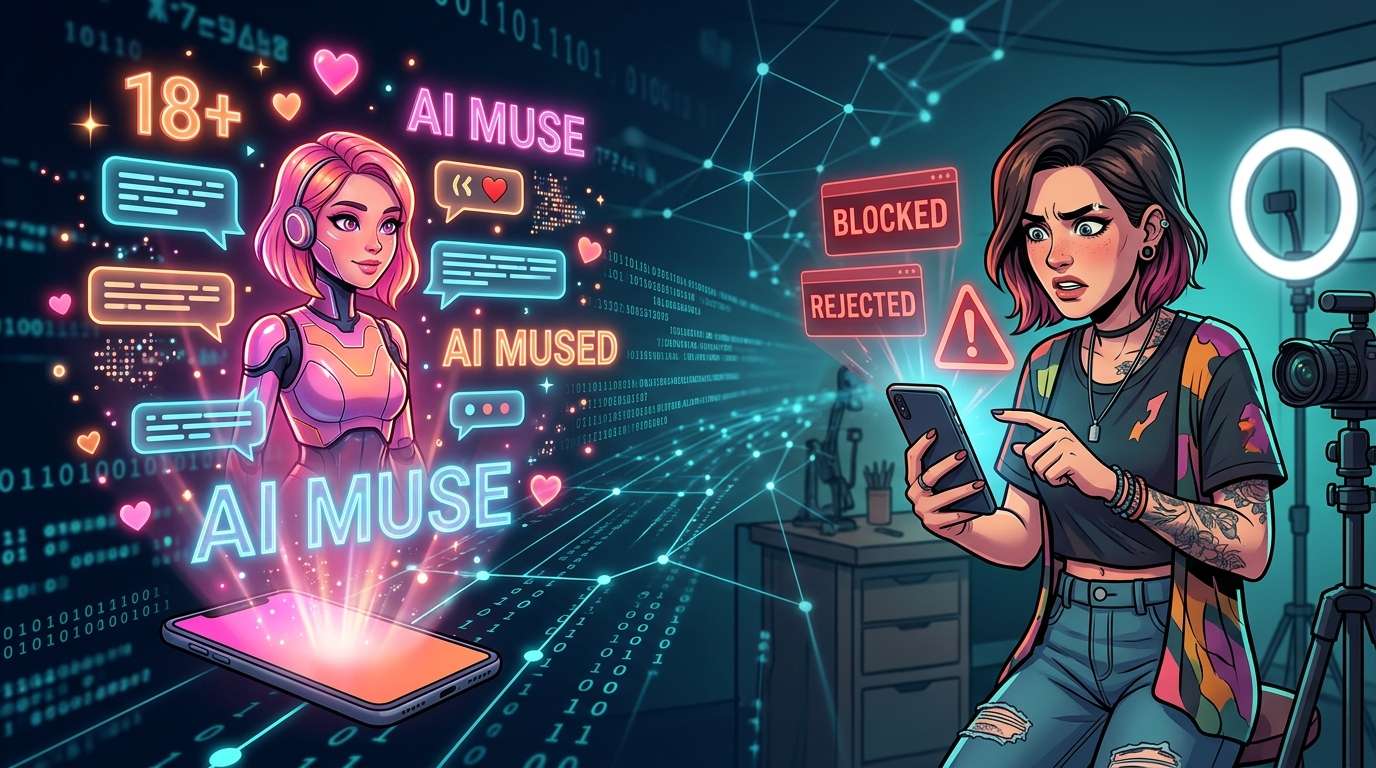
Meta’s AI agent Muse is said to allow explicit sexual text conversations with adult users in an app restricted to people 18 and older. Meanwhile, creators on the adult subscription service OnlyFans say they have had their accounts restricted and posts removed on Meta’s social media platforms. The difference between what AI is allowed to say and what human creators can publish has sparked debate over fairness on the platform.
Muse Allows Adult Text Conversations
Muse is an AI agent used through an interface resembling a messaging app. If users grant it access to personal data such as their calendars and email, it can take action proactively—for example, canceling a workout class that conflicts with a dinner reservation. Bolstered by the vast reach of Instagram and Facebook, it climbed the download rankings in its first month after launch. For millions of people, it was their first time trying an AI agent.
Meta allows users to have sexually explicit conversations with Muse in this app for adults. A company spokesperson previously said, in effect, that it would not block legal adult behavior. However, Muse generates explicit text only; images and videos are not included.
Even if it is text only, this means a channel for sexual exchanges has opened up to millions of adult users. That is where the debate begins.
Creators See an Imbalance on Social Media
Vanniall, a New York-based OnlyFans creator, was unsettled by this contrast. She says AI-generated deepfake images and videos that look just like her have circulated online, and that requests to have them removed are often unsuccessful. She also says she is constantly dealing with reports and appeals on Instagram. Her account, which has more than 100,000 followers, is currently restricted and can only be viewed by people who log in.
After hearing about Muse, she said it was unfair that AI could make money from people while real adults were not allowed even a little sensual expression.
Other creators share the same sentiment. Jiz Lee, who has worked behind the scenes in queer porn for many years and also runs an OnlyFans account, says Meta has removed their posts in the past. They have also said, in effect, that “AI seems to be allowed more than humans.” Tony Genius, who also appears in films, says his current Instagram account is his seventh in five years. It suggests the ongoing effort required just to maintain a place to post.
Meta’s Distinction Between ‘Conversation’ and ‘Promotion’
In response to these concerns, Meta spokesperson Tracy Clayton explained that private, one-to-one conversations between adults and personalized AI agents on a platform restricted to people 18 and older are very different from promoting or selling services on social media.
In Meta’s view, then, the rules differ depending on where the interaction takes place. The idea is that a public social network, visible to anyone, calls for different considerations than a closed space for conversation that requires age verification.
But creators’ concerns are not limited to what they can express. Social media is a gateway to finding new subscribers. If that gateway is difficult to use, their income can suffer. Some other social media platforms in the United States do allow adult content. X is one of the main places where many OnlyFans creators attract subscribers and connect with fans, and quite a few adult performers have moved to Bluesky. The fact that Meta’s policies are not the only option is also part of the debate.
From the creators’ perspective, conversational AI can handle sexual exchanges smoothly while they themselves face restrictions on promotional platforms. That disconnect is at the heart of their frustration.
Questions About AI Training and the Place of Human Creators
The issues extend beyond social media policies. Jiz Lee says they want to know what data Muse was trained on and whether anyone was paid for that data. While acknowledging that the industry as a whole has been slow to respond, they say adult-content companies are beginning to include AI-use policies in their official contracts. The aim is to prevent performers from being absorbed wholesale into AI training data.
Tony Genius says that when ads for AI agents run at award ceremonies, the audience erupts in boos. He worries that fully AI-generated porn could eventually take jobs away from human performers. At the same time, he sees current AI tools as useful for marketing work by independent creators, such as automatically cutting clips from videos for social media.
What’s interesting is that one person can hold two views of AI at once. Genius says she would be open to working with a tech company to create an AI version of herself that fans could message. She wants to find a way for human performers to keep earning a living without being pushed out or having their work used to train AI without permission. For now, she feels that being human and authentic is at the heart of connecting with an audience.
By contrast, Vanniall’s position is clear. At least when it comes to Meta’s Muse, she urges people to “stop downloading that app.” Her argument is that there’s no need to give Meta any more money or personal information.
Genius asks why, if Muse is restricted to people 18 and older, social media platforms can’t also create spaces for adults—and jokingly even suggests the name “Instacam.” Why make adults-only spaces for AI conversations but not for content posted by people? It remains to be seen how Meta will answer that question.









Comments