
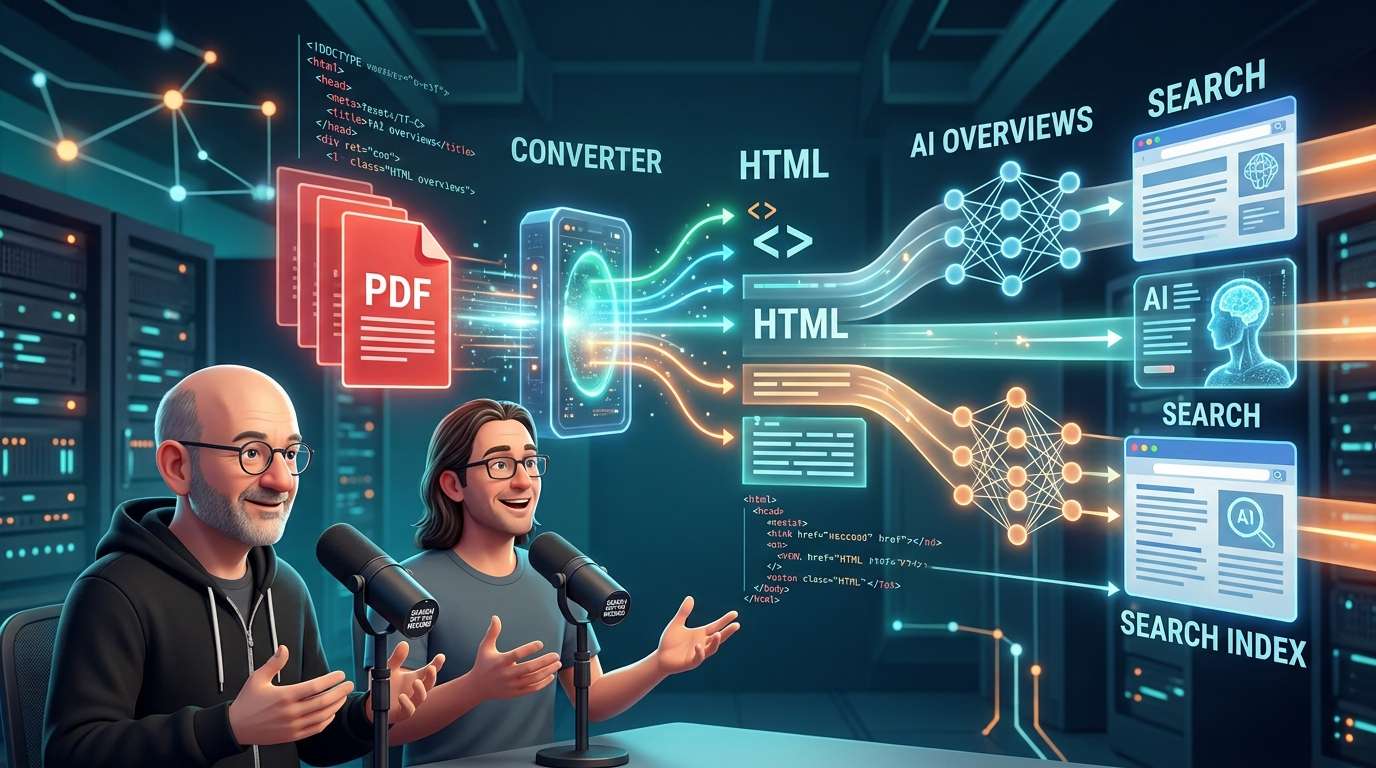
Google’s John Mueller and Martin Splitt explained how the company handles PDFs in search on its podcast. Search uses a dedicated conversion feature to turn PDFs into HTML, and then uses that HTML version for indexing. They said links in PDFs are also recognized after conversion and that PDFs may appear in AI Overviews and AI Mode, as well as in regular search results.
PDFs aren’t files that search leaves out
You may have heard at some point that “PDFs are bad for SEO.” After hearing this explanation, that impression may need a slight adjustment.
According to Splitt, Google’s search system has a component called a converter. It runs right after rendering, before a decision is made about whether to index a file, and routes processing based on the file format. It supports a wide range of formats, including rich text, documents and Excel files, and the PDF converter is one of its tools.
The converter’s output is HTML, so almost all subsequent stages work with HTML alone. Rather than opening a PDF in a viewer and looking through its contents, the system essentially puts the PDF on the same footing as a web page.
Why links work
The same process explains why links embedded in PDFs work just like regular links. Splitt said the system converts PDFs into HTML that stays as faithful as possible to the original format, allowing it to capture elements such as links. Mueller added that links work because Google converts PDFs into a form similar to web pages, which it is accustomed to handling.
For companies that distribute brochures or information pages as PDFs, this means links from those documents to their own websites may not go to waste.
They can appear in search and AI Mode
The conversion process also explains why PDFs may appear in AI Mode. As with regular search, the converted HTML is indexed, which means it can also show up in AI Overviews and AI Mode. Splitt said indexing and ranking work much the same way as they do for other documents.
In other words, PDFs aren’t treated as a separate category in AI search. If they’re included in the search index, they can enter through the same door as other content.
Image-only PDFs have a catch
One thing to keep in mind is that not all PDFs can be read as text. Some may look like documents but contain only images, such as PDFs made by saving scanned pages as images.
Splitt offered a simple rule of thumb: try selecting and copying text from the PDF and pasting it into a text editor. If the text can be pasted, it can be converted and used for ranking. Mueller also said that text that can be indexed can be used in search.
Splitt stopped short of giving a definitive explanation of how images within PDFs are handled. Regular images are processed by passing their URLs to the image search pipeline, but images in PDFs don’t have individual URLs. His current view is that they therefore may not be processed the same way as regular images in image search. He also noted that this could change in the future. As for file size limits, he said there is likely a separate fetching limit beyond the one for HTML, but gave no specific figure.
Why choose PDF, and why HTML is easier to use
So, should you avoid creating PDFs? Splitt’s answer was: “If the content calls for it, that’s fine.” He said PDFs make sense when you need precise control over how a document looks when printed, or when it needs to be interactive, such as a form. He gave the example of a PDF reservation form for a hotel.
Restaurant menus also came up. Many restaurants publish PDFs made by a print shop, and the view was that doing so is much better than not publishing a menu at all. Mueller agreed, saying that if the choice is between publishing a menu and not publishing one, it’s better to publish it as a PDF.
But if the choice is between a PDF and a regular web page, Mueller said he prefers the latter because it’s easier to interact with. If the same content can be put in HTML, that alone makes things a little easier, he said. Splitt also said he prefers HTML for its flexibility.
Making things easier for search engines
The takeaway from this explanation isn’t that PDFs are either good or bad for search. What matters is how short the path is to the information.
PDFs pass through an extra conversion step before they enter search. So if you can provide the same content in HTML, it’s generally best to make it easy for both search engines and readers from the outset. HTML’s advantages—being readable as soon as a page opens and displaying reliably on smartphones—also make it more user-friendly.
If you’re reviewing PDFs on your company’s website, first check whether their text can be copied. Then sort out which content could also be published in HTML. That’s a practical place to start.









Comments