
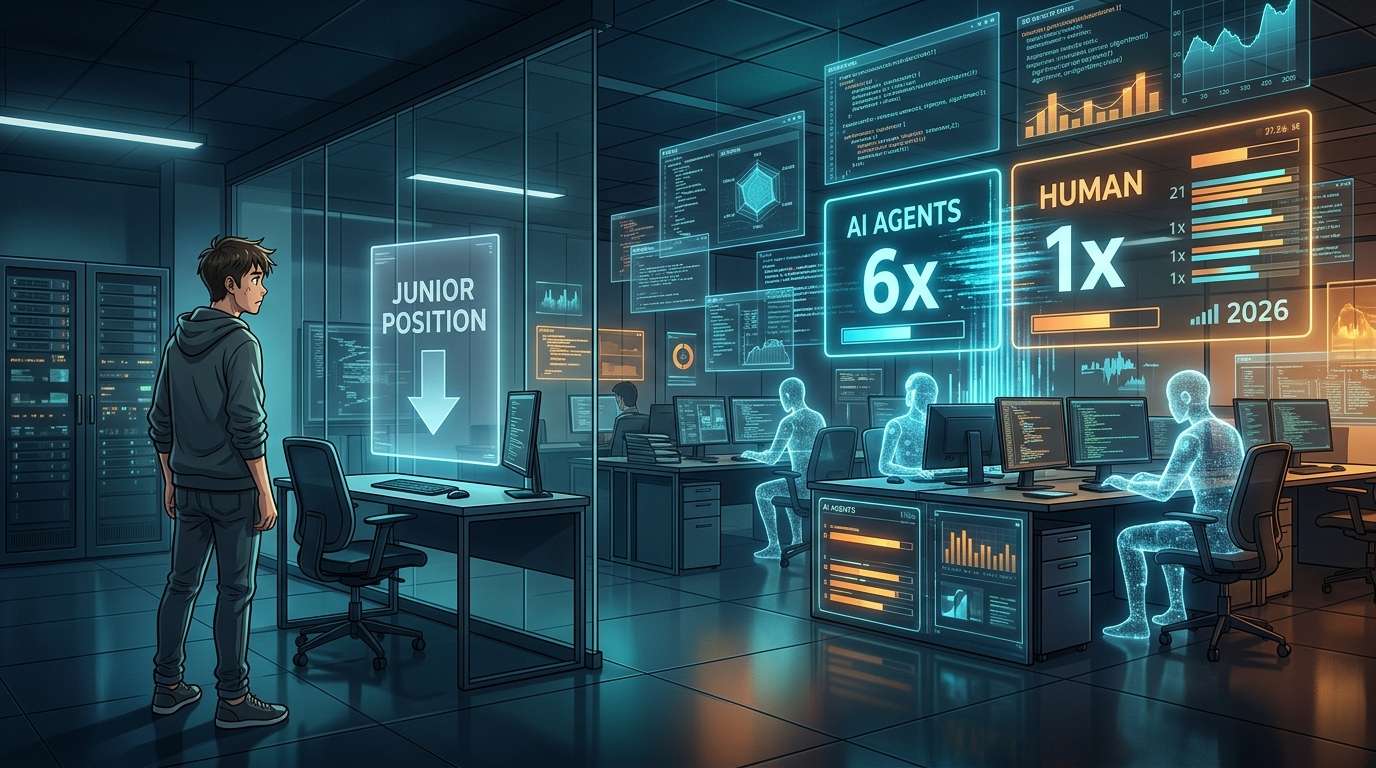
An internal survey released by AI company Anthropic found a sharp decline in early-career hiring in its technical division. The share of new hires who were early-career employees fell from 27% in early 2025 to 9%. The company also announced that in August 2026, its AI agents were operating six times as many hours as its employees.
As AI hours grow, early-career jobs are disappearing
Let’s look at the numbers. In Anthropic’s technical division, early-career employees’ share of the workforce fell from 21% in early 2025 to 14%. The drop was even steeper among new hires, with their share declining from 27% to 9%. The share of publicly listed openings aimed at early-career candidates also fell to 6%, with the decline becoming noticeable around December 2025, according to the survey.
The nontechnical division presents a contrast. It saw no major changes and remained broadly stable. In other words, this is not a companywide trend; it is concentrated in technical roles, where AI agents have made the deepest inroads.
The company cites improvements in AI agents’ capabilities as the reason. Early-career hiring fell most in roles where Claude handles a high proportion of complex tasks. The mindset may be quietly shifting from “hire because we don’t have enough people” to “keep people only for the work AI can’t handle.”
From coding to contract processing
At Anthropic, Claude is increasingly being entrusted with tasks such as writing code and finding bugs. AI agents’ operating hours have exceeded those of humans since March 2026. As of August, the ratio was 6 to 1 across the company, widening to 19 to 1 in the research division. That means AI is working the equivalent of 19 people’s worth of hours alongside each researcher.
The company has also released productivity metrics by department. Engineers made 5.1 times as many code commits, data scientists ran 3.1 times as many queries, and the legal team processed 3.1 times as many contracts. Sales closed 1.7 times as many deals, while recruiters made 1.4 times as many hires and the accounting team processed 1.4 times as many invoices.
One point worth noting is that the gains vary by department. AI is a better fit for work whose output is tangible and accumulates, such as coding, while the increases are more modest in sales and recruiting, which involve negotiations with people. This helps explain why the decline in early-career hiring has been concentrated in the technical division.
Anthropic is also a special case
The survey itself describes Anthropic as a special case. The company is a software business that has adopted AI to an exceptional degree, and its findings cannot simply be applied to the economy as a whole. Rapid business growth and employees’ voluntary use of AI tools may also have influenced the numbers.
So far, measurable AI-driven productivity gains have not appeared across the economy as a whole. Rather than assuming the same changes will reach your own workplace soon, it is more appropriate to read this as an early example of what is happening at a company where AI adoption is especially advanced.
Can efficiency and workforce development go hand in hand?
Early-career jobs are not merely a source of inexpensive labor. They are also an entry point where people gain experience and develop expertise. Today’s seasoned specialists built their skills over years in the very entry-level roles that are now disappearing.
Nolan Lovett, a researcher at NATO Special Operations University, describes this situation as a “tragedy of the cognitive commons” in a paper. If individual companies replace entry-level positions with AI, they reap the efficiency gains. But when experienced workers are needed a few years later, the resulting costs are spread across society as a whole. It is a workforce version of the classic “tragedy of the commons,” in which people collectively deplete a shared pasture.
Lovett expects the effects to emerge in earnest between 2030 and 2045. That is because today’s working experts were trained five to 20 years ago. Software development, financial analysis and legal research are considered especially vulnerable fields.
When the work people do changes
That forecast assumes humans will still be doing these jobs in the future. Anthropic itself appears to take a different view. The company has previously suggested that programmers and call-center workers may eventually need to move into jobs such as electricians or nurses.
The decline in early-career hiring raises questions that go beyond one company’s hiring policies. How should the time and money saved through greater efficiency be invested in developing the next generation? And how can companies preserve places for apprentices in workplaces where AI works six times as many hours as people? The responsibility for finding answers lies with the companies adopting AI.









Comments