
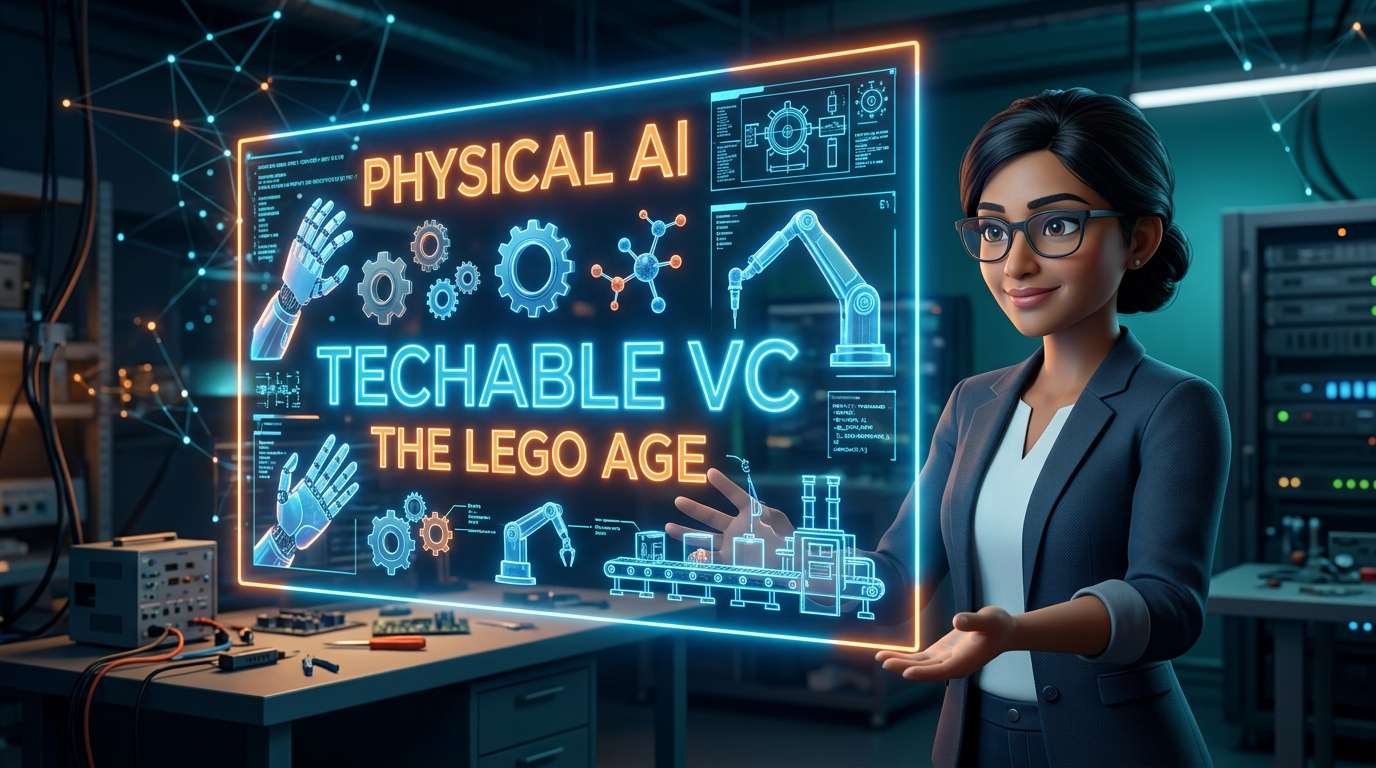
Amriya Vishwanath, who spent seven years leading product marketing for robotics platforms at NVIDIA, has launched Techable VC, an early-stage investment firm, and invests in physical AI as its founder and managing partner. On TechCrunch’s “Equity” podcast, she discussed the scope of physical AI, where the robotics industry stands today, and how she evaluates potential investments. She described the state of the robotics industry as its “Lego era,” when the basic components are still being put together.
Physical AI doesn’t have to take the form of a robot
When people hear “embodied AI,” or physical AI, many probably picture videos of humanoid robots walking or dancing. But Vishwanath’s definition is much broader. She points to “molecules, materials, pharmaceuticals” and machines working on factory lines.
In other words, physical AI isn’t about expanding the range of robot types; it’s about AI reaching beyond screens to interact with the world itself. AI that generates text and images is extending its reach to physical materials and processes. Seen this way, potential investments aren’t limited to robotics companies. In fact, her fund focuses on three areas: robotics, materials science and life sciences.
I find this broader definition persuasive. Developing new drugs and materials involves repeated cycles of prototyping and testing. AI could change how time is spent in laboratories and factories. Even without a visible robotic arm, AI can still act on the physical world.
Reassembling the components before the ChatGPT moment
There is one big hope in the world of robotics: that robots will have a moment like the one chatbots did when ChatGPT launched in late 2022 and their capabilities suddenly drew widespread attention. The idea is that this moment will come for robots through general-purpose foundation models. On this year’s “Equity,” Pym De Witte, CEO of General Intuition, said that a single general-purpose model could make much of today’s specialized robot development unnecessary.
Vishwanath takes a different view. She says foundational elements such as actuators, robotic hands, software and safety standards are still being rebuilt. That’s what she means by the “Lego era.” Until the blocks’ shapes and specifications are standardized, even the smartest blueprint won’t produce the finished product as intended.
This is something I’d like readers to consider. A chatbot operates entirely on a screen. A robot, by contrast, moves heavy objects and works near people. Unless components are precise and durable, and standards are in place to prevent accidents, a smart model alone won’t get a robot onto the factory floor. The unglamorous work of building a solid foundation behind flashy demos may be where the real competition in this field lies.
Investment criteria: labor shortages and strain on medical staff
So what criteria does she use when writing her first check? On the podcast, she said the best opportunities lie in businesses that solve major problems. The examples she cited were a family-run factory that can’t find workers and surgeons facing burnout.
The key question is not how new the technology is, but whose problem it solves and how. This approach is relevant not just to investors, but also to executives and managers looking to bring AI into their businesses. Both understaffed factories and overburdened healthcare settings need systems that work reliably, not hype.
She also describes this approach as “conscious automation.” The term can be understood as pointing toward designing automation around the challenges on the ground, rather than simply replacing work that people have been doing.
An investor’s network can also be an asset for founders
Another striking aspect is how she works with founders. She believes a VC itself should be a competitive advantage—a “moat”—for founders. Rather than simply providing capital and walking away, she wants to help protect and grow the businesses she backs.
The foundation for that is the network she built during her years at NVIDIA. She says she uses those connections to vet the technology of prospective investments and introduce them to customers. Her seven years working on NVIDIA’s robotics platforms appear to have given her both a discerning eye for technology and connections with companies.
For physical AI businesses, success or failure depends on their proximity to real-world settings such as factories, hospitals and research institutions—more so than for software-only startups. An investor who can offer a path into those settings, in addition to funding, should be a valuable ally for founders. She is also one of the earliest female executives to leave NVIDIA and launch her own early-stage investment fund.
The podcast also explored the respective strengths of the United States and China, as well as the idea that humanoid robots should be useful for more than just dancing. The future of robotics is entering an era defined less by flashy videos than by steady deployment in real-world settings.


Comments