
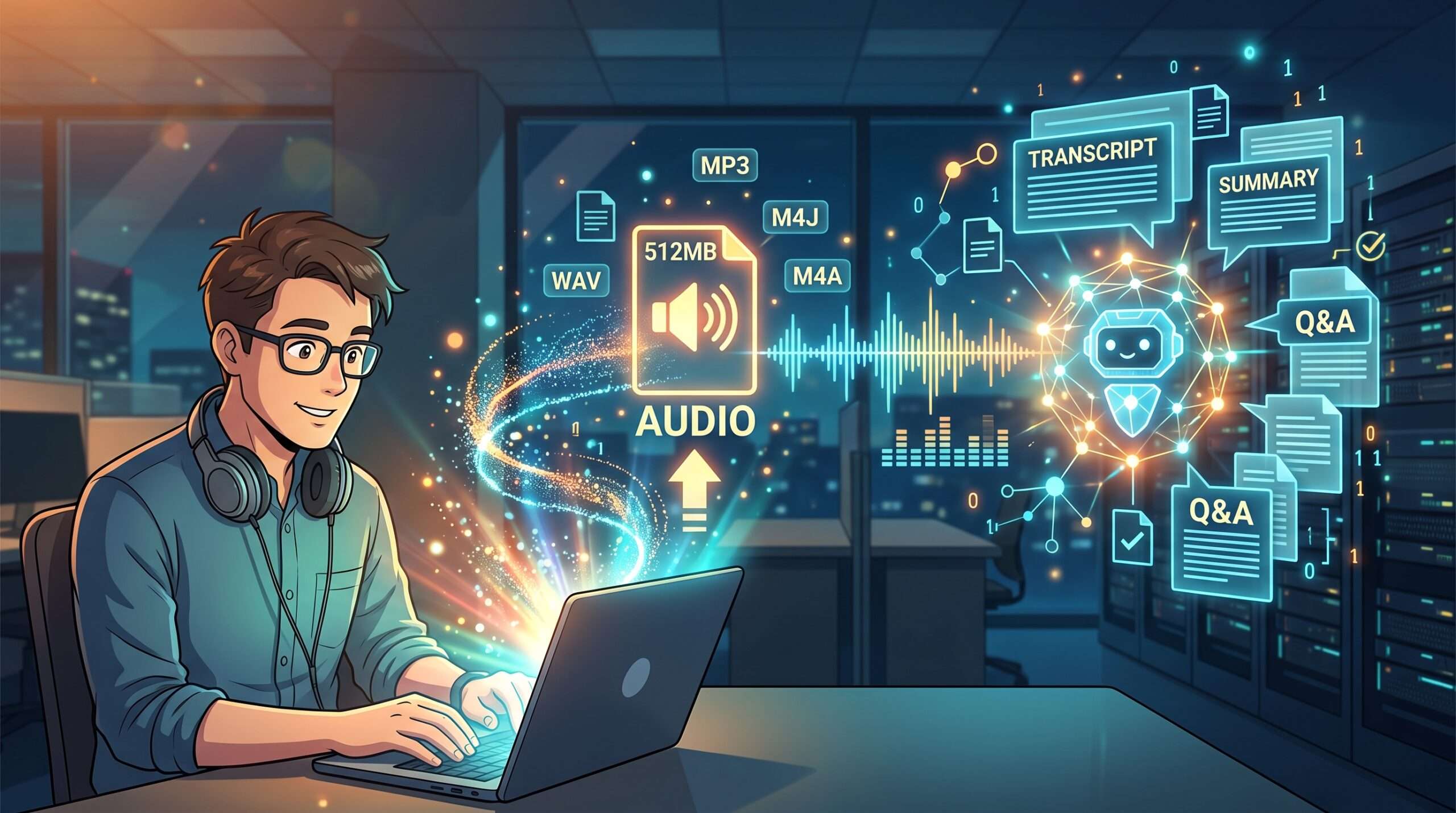
OpenAI, the U.S. company, announced by October 9, 2026 (Japan time) that ChatGPT now supports audio file uploads. Paid users can upload recordings to transcribe and summarize them, as well as ask questions about their contents. The file size limit is 512 MB.
Users Can Ask About a Recording, Not Just Transcribe It
With this update, users can upload saved audio files to ChatGPT and convert their contents to text or organize the key points. The feature is available to paid users.
One notable point is that users can ask questions about a recording in addition to transcribing it. They can choose to read a full text transcript or ask about specific information they want to know.
For example, users could pull together the main points of a discussion from a meeting recording or briefly summarize a lecture. Rather than simply saving a recording and stopping there, users can think of this as a tool for retrieving the information they need.
Broad Format Support, but Limits on Long Recordings
Supported formats include WAV, MP3/MPEG, OGG/OGA, PCM, FLAC, AAC, and M4A. WebM and MP4 are also supported, but only for audio-only files. The fact that MP4 is supported does not mean this announcement covers video files in general.
The file size limit is 512 MB, but that figure does not indicate how long a recording can be processed. Long recordings may be split into segments for processing, and timeouts are also possible.
In practice, users need to consider recording length in addition to file format and size. Even files within the limit may not have long recordings processed in a single pass.
Check What Was Said and Who Said It Before Using a Summary
Transcripts may contain errors in what was said or in speaker identification—determining who spoke. Accuracy in understanding audio and transcribing it may also vary by language.
For meetings or interviews, it is worth distinguishing the readability of a summary from the accuracy of the record. When verifying important statements or speakers, users should not rely solely on generated text; it is best to check it against the original audio.
The materials provided do not include figures for accuracy or error rates by language. They also do not specify accuracy for individual languages, including Japanese, or how many hours of audio can be processed.








Comments