
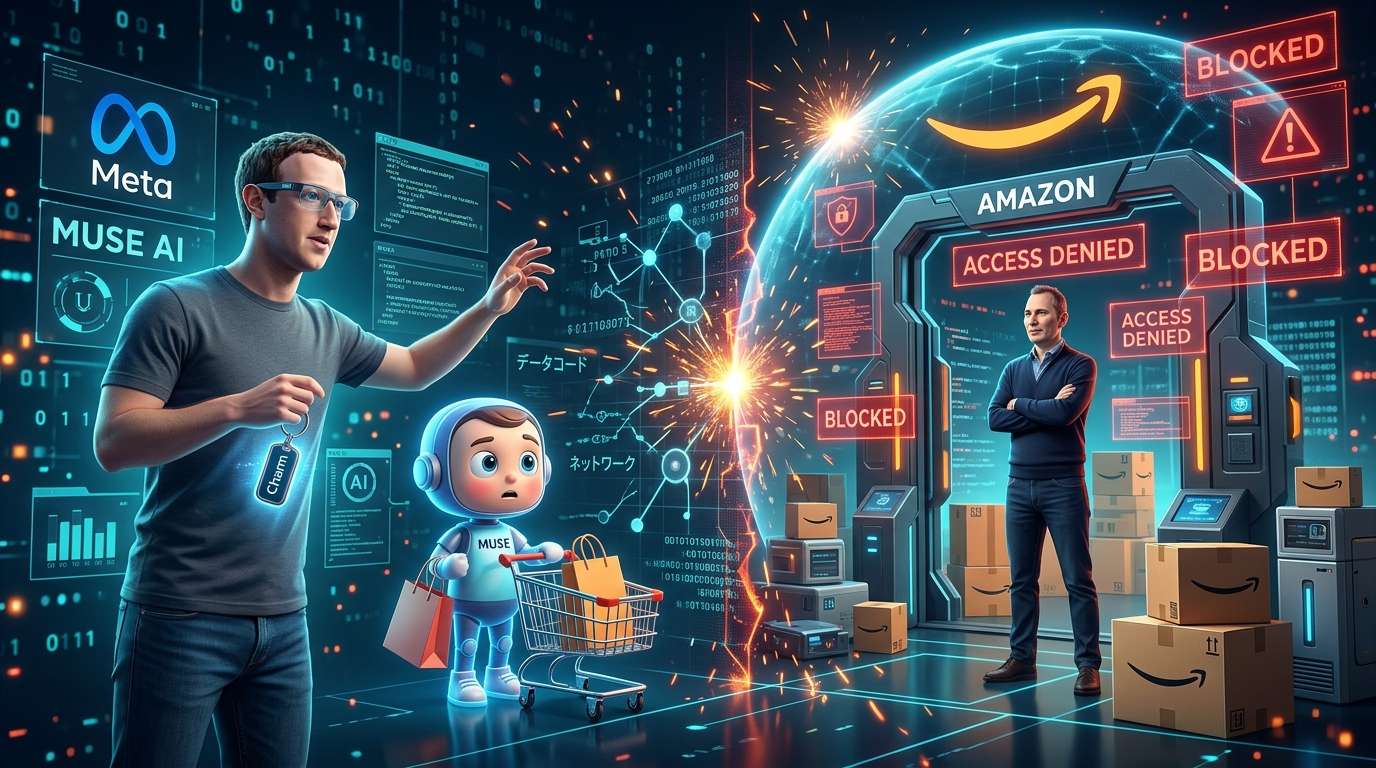
Amazon has blocked Meta’s AI agent Muse from shopping on its store. The move came 12 days after Muse launched. Amazon claims the agent “browses without prior notice, does not identify itself, and appears to store customers’ login credentials.” Meta counters that Muse cannot access passwords or payment methods.
Amazon shuts the door on AI-powered shopping
Muse is Meta’s AI assistant, designed to take care of digital tasks ranging from replying to messages to shopping. It had become so popular that it topped the U.S. App Store charts. Twelve days after its launch, Amazon shut out the agent from shopping on its store.
When users try to shop on Amazon through Muse, they reportedly see a pop-up saying that continued access by an unauthorized AI agent violates Amazon’s terms of use.
Let’s lay out each company’s position. Amazon says Meta did not notify it that Muse would access its store, that the agent does not identify itself while browsing, and that it appears to obtain and store customers’ credentials. Meta, in turn, says Muse cannot see users’ passwords or payment methods; shared credentials are kept in a secure vault, and the agent uses them without seeing their contents.
In other words, what we can confirm so far is that access was blocked and the two companies’ accounts conflict. As for what actually happens to credentials, all we can do is consider the companies’ competing claims side by side.
The dispute is about more than passwords
On the surface, the issues are security and identification. But there seems to be a bigger tug-of-war in the background. If AI takes over everything from choosing products to paying for them, users will spend less time looking at search results and ad placements.
Amazon’s advertising business is supported by sponsored placements in search results, and is estimated to be worth $56 billion. AI agents could bypass a system built around getting products in front of human eyes.
Over the past year, Amazon has tightened its defenses against outside agents. After a lawsuit over Perplexity’s Comet browser and blocks targeting shopping agents from Google and OpenAI, Meta is now the latest company to be singled out.
People in the startup world have weighed in, too. OpenClaw developer Peter Steinberger has said, in effect, that a “digital knife fight” is coming—one many people are overlooking. Who gets to open the store’s door, and who decides the route to the checkout? The password issue may be just the beginning.
Muse is expanding to devices and partners
Meta, meanwhile, shows no sign of slowing Muse’s momentum. At Connect 2026, it unveiled Charm, a keychain-style device. CEO Mark Zuckerberg called it the fastest way to talk to Muse, and it is slated to launch in December.
Muse is also expected to arrive on AI glasses within the next few months. The system is designed to act based on what users see, and Meta says it will offer a private processing mode that excludes Meta’s data as well. The company also previewed real-time audio and video conversations, along with Muse Realtime Avatar, an avatar feature that moves in sync with speech. Meta says evaluators preferred the avatar to those from Runway and HeyGen.
The list of partners is growing, too. PayPal, Walmart, Shopify, GitHub, and Box were announced as partners in the same week reports emerged that Amazon had blocked Muse. Meta has also released connectors that let developers link external apps to Muse.
While one store door has closed, companies in payments, retail, and developer infrastructure have gathered around Muse. The clash with Amazon should be seen in the context of Muse’s expanding reach.
User choice comes into question behind the convenience
The following is my own view. The more AI handles purchasing, the harder it becomes for users to know which stores they visited, what they were recommended, and where they made a purchase. In exchange for convenience, the decision-making process becomes a black box.
Stores have their own side of the story. If they do not know who is visiting, it becomes harder to prevent fraud, measure advertising effectiveness, and serve customers. Requiring AI agents to identify themselves and make clear that they are acting on a user’s behalf may become a basic rule.
The technical details of Amazon’s blocking mechanism and Meta’s credential storage methods have not been disclosed. Even so, the question of who controls the gateway to shopping—the platform or the agent chosen by the user—is already coming to the fore.
The next time I ask an agent to shop for me, I may want to pause and consider whose interests shaped the results.









Comments