
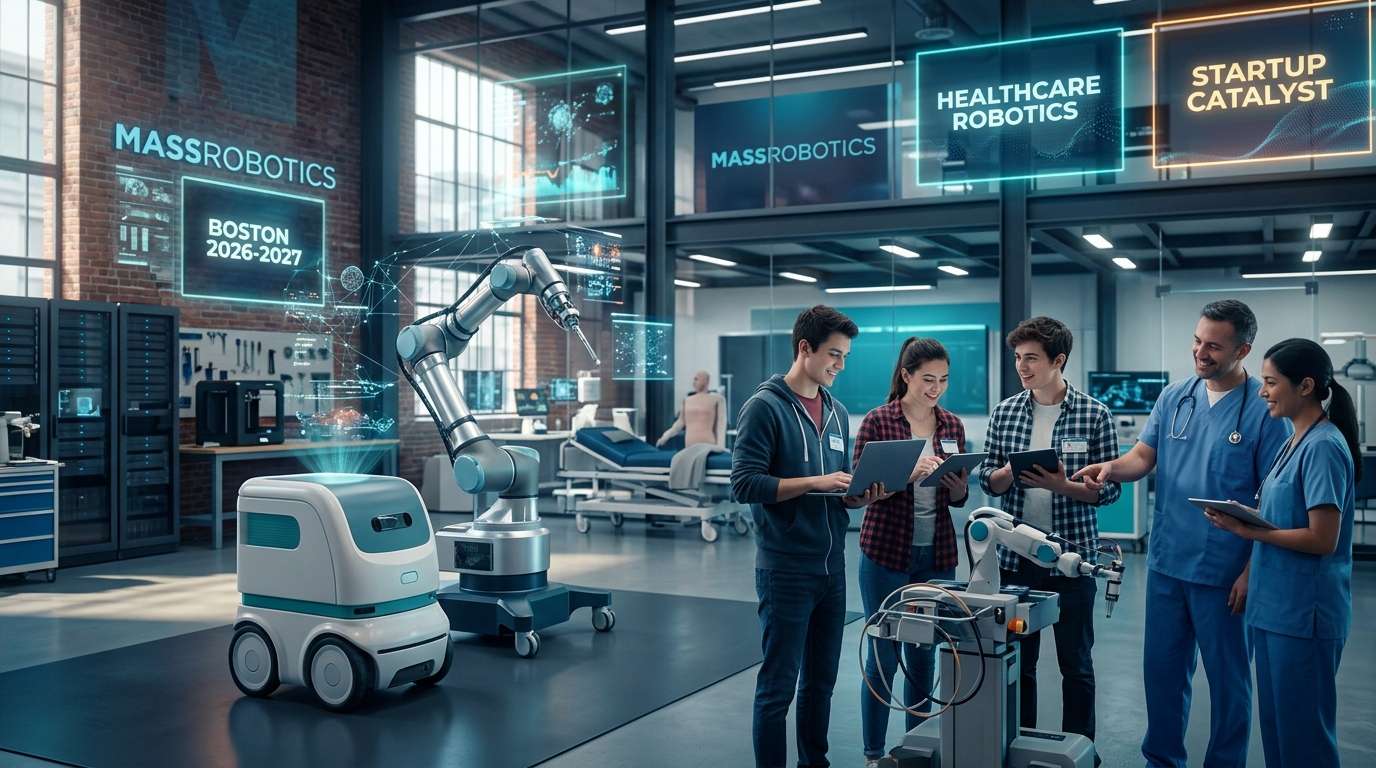
Boston-based nonprofit MassRobotics is accepting applications for the sixth cohort of its Healthcare Robotics Startup Catalyst Program, which supports robotics startups in the healthcare and life sciences sectors. Applications are due by December 31, 2026, and the four-month program runs from February to June 2027. At the end of the program, companies are expected to showcase their work at the Robotics Summit & Expo in Boston.
From prototype to hospital floor: a four-month hands-on program
Medical robots are not products where the job is done once they can move. Do they fit into clinical workflows? Can doctors and nurses use them with confidence? How should they be explained to regulators? Barriers beyond the technology emerge one after another from the earliest stages of development. MassRobotics’ program gives startups trying to overcome those obstacles on their own access to the expertise and networks of experienced professionals.
The program is non-equity, meaning it takes no ownership stake. It is open to companies working on robotics or automation technologies in the medical and biotech fields. During the program, participants work toward concrete goals such as prototyping a proof of concept, designing a pilot deployment, planning for regulatory compliance, and integrating systems. The program is structured to connect participants with senior mentors from corporate partners, as well as practicing clinicians and leading organizations in the medical field.
From the lab to the operating room
Eligible areas are broad and include laboratory and pharmaceutical automation, diagnostic and imaging workflows, hospital logistics, operating-room automation, rehabilitation and assistive devices, and robots for surgery and interventions. Foundational technologies such as sensing, precision control, edge AI, and medical-device cybersecurity are also eligible.
The program is open to international companies, and applicants at funding stages ranging from seed to Series C are welcome. The selection process considers technological maturity, clinical relevance, the ability to achieve near-term milestones, fit with the program, and compatibility with mentors. Teams that can advance to a proof of concept within the four-month period are especially welcome.
Intel brings an edge AI perspective
Intel has newly joined the steering committee for the sixth cohort. It joins Festo, Novanta, and the U.S. division of Mitsubishi Electric, all of which have been involved since the program’s launch. Intel’s Health and Life Sciences division says it will contribute expertise in edge AI and on-device computing for robots that support surgery and procedures, as well as operating-room automation.
Edge AI refers to processing AI workloads close to the device, without relying on the cloud. In settings such as surgery, where even a moment’s delay is unacceptable, the ability to make decisions on the spot without going through a network is a design advantage. According to program materials, interest in this area is also growing among this cohort’s participants. Having a company with chip expertise serve as a mentor could make it easier to get advice on designs that account not only for performance but also for real-world operations.
Past participants show the program’s reach
Since its launch in 2021, the program has hosted 35 companies. The teams, ranging from pre-seed to Series A, are based in locations around the world, including Boston, Toronto, Paris, Barcelona, and Sydney. MassRobotics says its graduates include a publicly listed company, several companies moving forward with proof-of-concept deployments, and participants that have reported raising more than $180 million in total.
Of course, these figures reflect results reported by participating companies and cannot be attributed to the program’s support alone. Still, the fact that several companies have advanced from early prototypes to stages closer to market suggests that the four-month program serves as a way to help businesses take their next step.
Bingda Li, CEO of Whelix, which develops robots for automating cell culture, was pleased to be able to consult directly with people who had faced the same challenges. Johannes Linzbach of Festo also pointed to the growth of companies such as Tenomix, after three years of supporting the program as a founding member.
From selection to showcasing results
Evaluations and interviews will take place from January 1 to 20, 2027, after the application deadline. The participating companies are scheduled to be announced on January 29. Following the program, which runs from February to June, they will showcase their work at the Robotics Summit & Expo.
The program begins with onboarding and goal-setting, followed by work sessions with mentors every other week. Workshops tailored to participants’ needs will also cover topics such as regulatory strategy, cybersecurity and software bills of materials (SBOMs), clinical workflows, and pilot deployment design.
Technical maturity alone is not enough to turn a medical robot into a product. Success depends on advancing clinical adoption, regulatory readiness, and business development at the same time. The companies in the sixth cohort—and the challenges they tackle first—will be worth watching when they present their work in Boston in June 2027.






Comments