
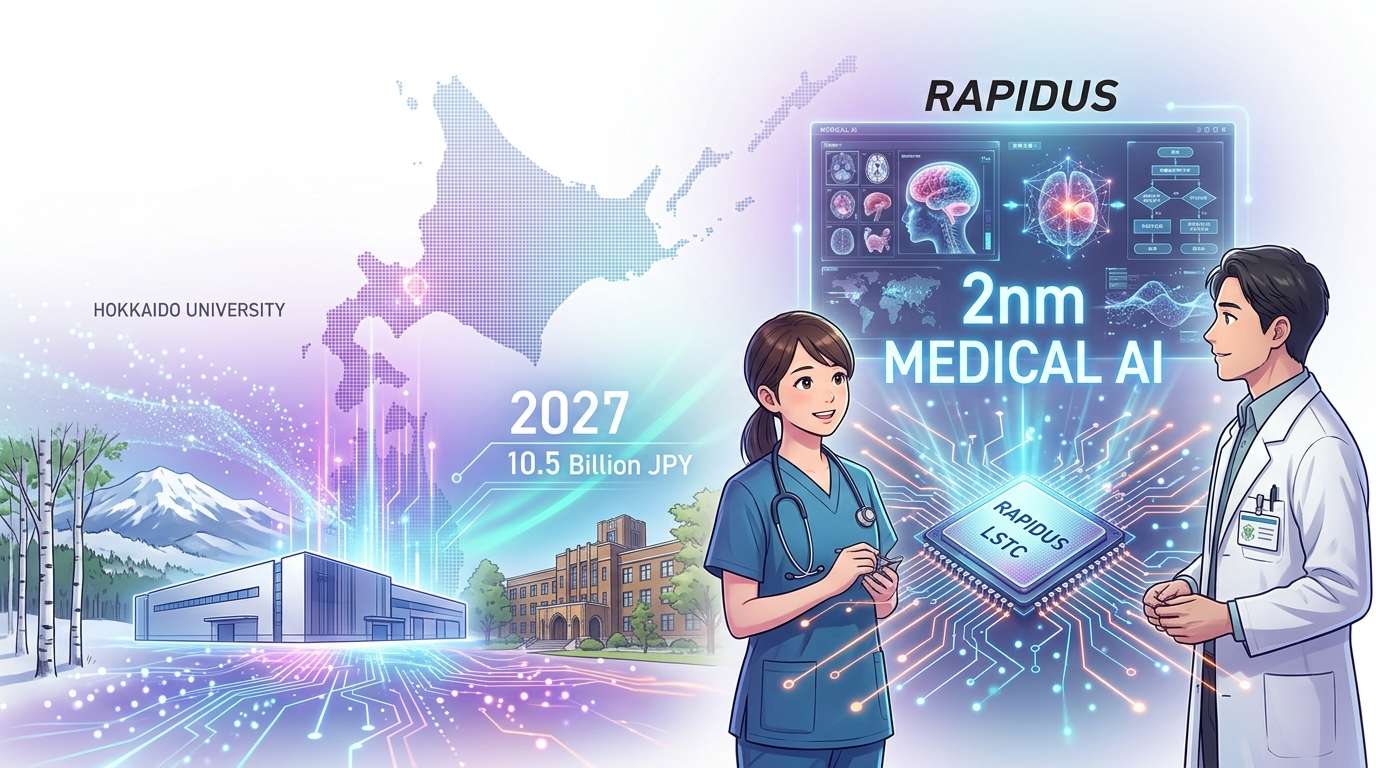
Rapidus (Tokyo), the Leading-edge Semiconductor Technology Center (LSTC, Tokyo), Hokkaido University and others announced on October 20 that they would develop a medical AI system using semiconductors with circuit widths in the 2-nanometer range. The AI will support surgery and diagnostic imaging, and the total project cost is expected to reach ¥10.5 billion. The initiative aims to create practical applications through industry-academia collaboration, with an eye toward semiconductors made by Rapidus, whose factory in Chitose, Hokkaido, is scheduled to begin mass production in fiscal 2027.
What comes next for semiconductors: finding uses
Making the most advanced semiconductors is not the finish line. What products and services will use them, and whom will they help? Only when those questions have answers do massive investments take on meaning. This announcement tackles precisely that question of how the technology will be used.
The initiative is based in Hokkaido. Hokkaido University is taking part, and the partners have identified medical AI as a concrete application, looking ahead to mass production at Rapidus’s Chitose factory beginning in fiscal 2027. Rapidus, LSTC, Hokkaido University and others say they aim to work together to create practical applications for advanced semiconductors.
A circuit width of 2 nanometers refers to an extremely small scale: one nanometer is one-billionth of a meter. The circuits are orders of magnitude finer than the thickness of a human hair, and how to make use of such tiny circuits depends on the ideas of those who use semiconductors.
AI to support surgery and diagnostic imaging
The system under development is medical AI designed to support surgery, diagnostic imaging and other tasks. Its role is explicitly one of “support,” suggesting it is being designed as a tool that complements the judgment of medical professionals.
In medical settings, speed and accuracy are both essential when assessing conditions during surgery and reviewing images such as X-rays and CT scans. AI used in these situations needs the computing power to process large volumes of data in an instant. This is a field where high-performance semiconductors can play a major role.
At this stage, the announcement lays out the start of development and its goals. The system’s impact in medical settings is something that will have to be demonstrated over time.
Linking the ¥10.5 billion project to mass production plans
The total project cost is expected to reach ¥10.5 billion. The plan also calls for the government to cover the full cost through subsidies over five years. It is a case of the government backing an advanced field that would be a heavy burden to fund solely with private money.
The picture becomes clearer when the timelines are laid side by side. Rapidus plans to begin mass production in fiscal 2027, and development of the medical AI is set to proceed on a similar schedule. By the time the chips are ready, the medical system that will use them will also be taking shape. That synchronization may be the key to the plan.
Bringing manufacturers and users to the same table early on is significant for the semiconductor industry. Reflecting users’ needs in the design can reduce the risk that finished semiconductors will have nowhere to go. Semiconductors made in Hokkaido being put to medical use by a Hokkaido university: whether this region-based cycle bears fruit will be worth watching.








Comments