
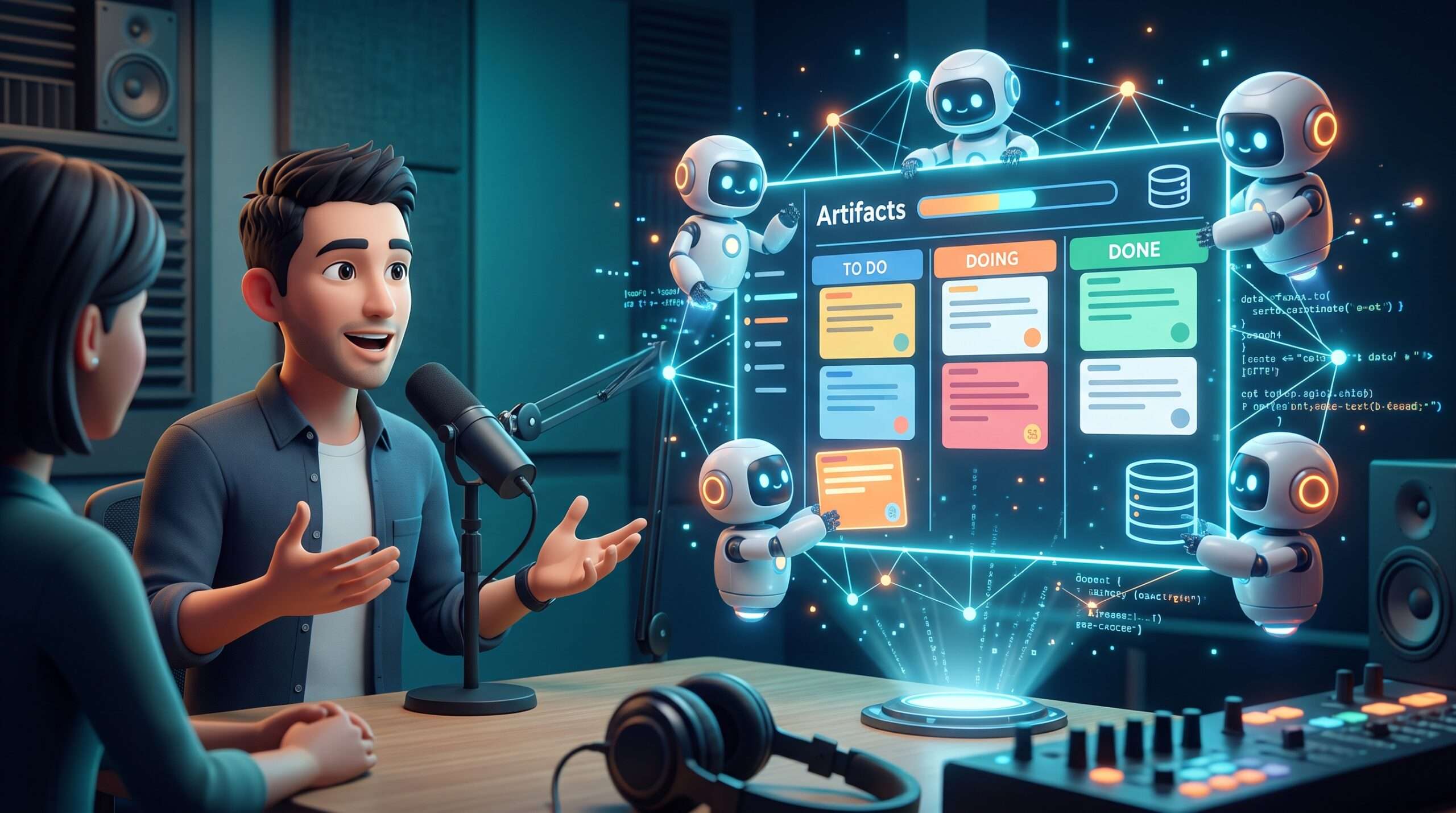
In a podcast interview, Anthropic technical staff member Thariq Shihipar recommended using Claude’s “Artifacts” to manage long-term projects and collaborate with AI agents. He outlined a vision for sharing work plans and the activities of multiple agents on screen, while noting that the infrastructure needed to make it happen is still under development.
Share the Big Picture of the Work, Not Just Requests in Chat
For Artifacts, introduced in 2024, Shihipar proposed using them as a dashboard for tracking project status. Rather than simply sending the AI instructions as needed, the idea is to work in a shared workspace that shows what is underway and what requirements need to be met.
One example he gave was kanban-style task management using cards. He described a system that stores task information in a database for multiple Claude agents to reference. An AI agent is an AI system that carries out work in response to instructions. When work is divided among multiple agents, a place is needed to see the overall picture, not just individual conversations.
The proposal shifts the focus from how to write prompts to how to share the status of work. For tasks involving requirements that extend to diagrams, code, or data structures, the idea is that it can be useful to communicate changes while looking at the material itself, rather than funneling everything through text exchanges.
How Should Chat and the Workspace Be Used?
However, adding more channels also means deciding how to use each one. In the interview, co-host SWYX asked how users should distinguish between feedback they give in Artifacts and instructions they send through Claude chat. One alternative, he suggested, would be to communicate everything through chat for simplicity.
Shihipar envisioned an interface where users could comment on an evolving work plan and check the work of multiple agents. He described Artifacts as a front end to the infrastructure that supports AI work.
The interface described here is not just a place to view completed work. It is a place to respond to plans in progress and adjust the direction of the work. The implied division of roles is that chat serves as the entry point for requests and consultations, while Artifacts is where users engage with specific work in view. However, this division has not been announced as a finalized specification.
A Vision That Separates Where AI Thinks From Where It Acts
On the technical side, Shihipar outlined an approach that separates the interface users see, where the AI makes decisions, and the environment where work is actually performed. The vision is for cloud-based AI to coordinate tasks, carry them out as needed on a local computer or remote execution environment, and display their status in Artifacts.
For example, even when multiple helper agents are each working on their own tasks and communicating with one another, users would be able to monitor their activity from a single interface. Separating AI decision-making from work performed on a local computer could also enable operation that does not depend on whether the computer is powered on.
This was not a claim that all these functions are already available through current Artifacts; it was a vision for the future outlined by Shihipar. He acknowledged that the infrastructure still needs to be built, and the interview did not specify when the overall vision might become available or provide a development timeline.



Comments