
Generative AI and AI agents can now create text, audio, and images, and even carry out actions across multiple services. Online services are finding it harder to tell whether they are dealing with a real person, an automated program, or an AI authorized by a human.
An article published by ZDNET Japan argues that companies need to rethink the concept of “verification (authentication)” by separating it according to what is being verified.
Humanlike automation is shaking the assumptions behind authentication
For a long time, the internet operated on the implicit assumption that there was a human on the other side of the screen. Bots and unauthorized access have existed for years, of course, but sustaining humanlike conversations, generating natural-sounding audio and realistic images, or operating across multiple services required considerable cost and technical expertise. Generative AI and AI agents have dramatically lowered that barrier.
The numbers reflect this shift. According to Cloudflare data, about 57% of web requests are automated bot traffic, reportedly surpassing human activity for the first time. HUMAN Security’s 2026 benchmark reports that traffic originating from AI agents increased 7,851% year over year in 2025. In Japan, the National Police Agency reported 10,237 recognized cases of social media-based investment and romance scams in 2024, with losses of about ¥127.2 billion.
These figures do not count only fraud involving AI. The key point is that the difficulty of determining whether someone online is real and trustworthy is becoming a challenge for society as a whole. This is about more than a rise in the number of bots: their volume is growing even as they become more convincing in their humanlike appearance. I think the fact that both trends are advancing at the same time is at the heart of this discussion.
When passwords and multifactor authentication aren’t enough to protect against threats
Corporate security has traditionally developed around protecting accounts. User IDs and passwords, multifactor authentication, device management, single sign-on, zero trust, and access control all remain valuable in the AI era.
That said, these measures mainly verify the legitimacy of “things” or “rights,” such as credentials, devices, and access privileges. If credentials are stolen, attackers can act like legitimate users. In video meetings, impersonation using AI-generated audio or video has become a real risk. In e-commerce and customer support, bots can carry on natural conversations while posting reviews, making inquiries and purchases, canceling orders, and claiming coupons.
AI agents make the picture even more complicated. Traditional anti-bot measures have largely focused on blocking access that does not come from a human. But more people will now entrust AI with actions on their behalf. Simply rejecting something because it is a bot could also block legitimate delegated actions. Companies need to establish which actions AI can handle and which require human approval.
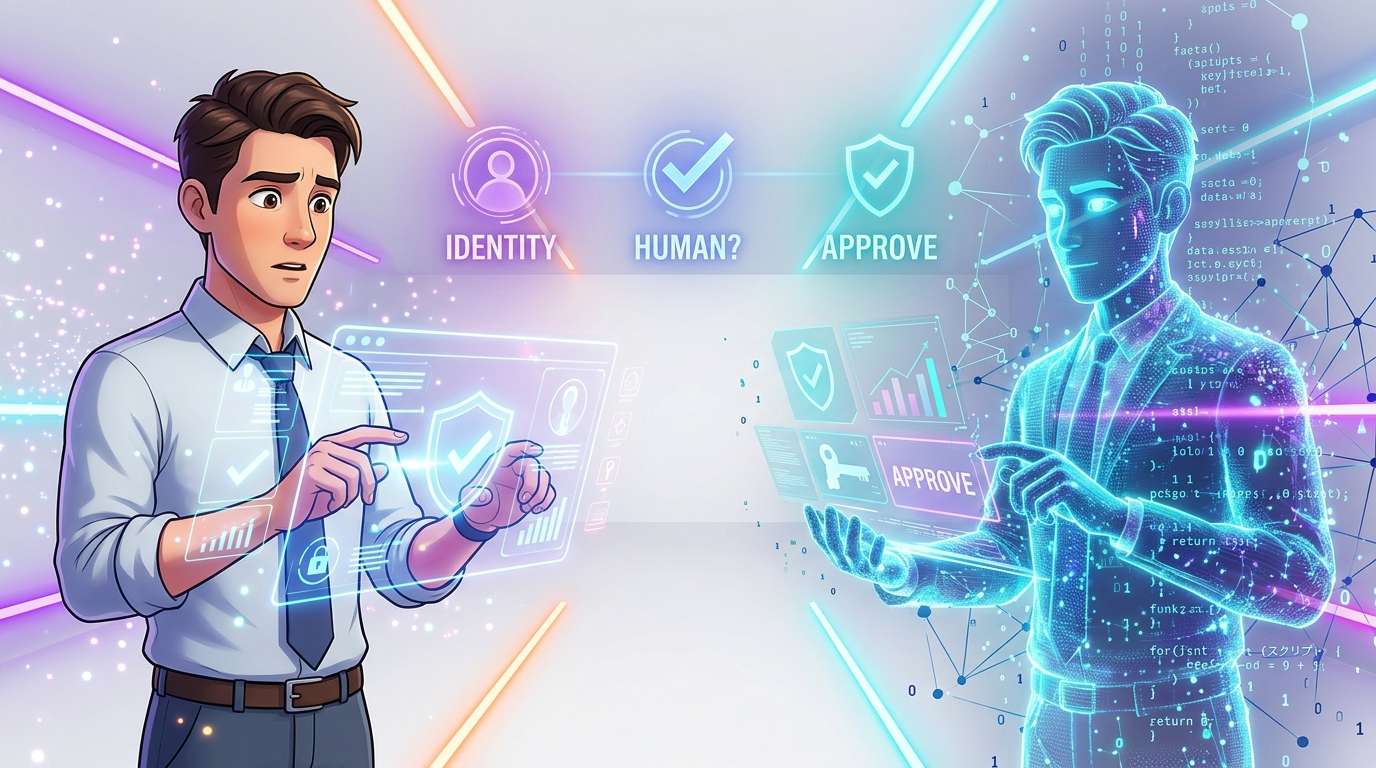
Is it the person, is it human, and was the action authorized?
One useful approach is to separate what needs to be verified into three categories.
First: legal identity verification
This verifies “who the person is” and is a long-established framework. In situations involving legal or contractual responsibilities—such as financial transactions, government procedures, mobile phone contracts, and electronic signatures—it is essential to verify a person’s identity through details such as their name, address, and date of birth.
Second: verifying that someone is human
This concept is called “Proof of Human.” It asks whether someone is a real person rather than a bot. A service does not necessarily need to know the person’s real name. It can be useful when real-name identification is not required—for example, to limit participation to one entry per person, curb multiple accounts, or indicate that the other party is a real person.
Third: verifying human intent and approval
This verifies whether actions taken by an AI agent are based on human intent or approval. AI may be able to handle information gathering and drafting, but high-risk actions—such as transferring money, signing contracts, accessing personal information, sending data externally, or changing administrator privileges—may require a record of human approval.
These three categories may seem similar, but they serve different purposes. In situations that require legal identity verification, confirming that someone is human may not be enough. Conversely, requiring excessive identity checks when real-name identification is unnecessary increases both the burden on users and privacy risks. Approval for AI actions should also be treated as a separate issue from identity verification and bot detection. The blanket assumption that “we’re safe because we verify identity” is becoming harder to sustain in the AI era.
Let AI work, keeping humans in the loop only for risky actions
The value of AI agents lies in their ability to streamline tasks such as routine work, gathering information, comparing options, preparing bookings, and drafting inquiries. If strong human checks are inserted into every action, much of the value of automation is lost.
At the same time, allowing high-risk actions to proceed without checks leaves issues such as accountability, misuse, auditing, and explainability unresolved. That is why it is important to calibrate checks according to risk. Low-risk activities such as reading or drafting should proceed with as little friction as possible, while actions with greater importance, higher trust requirements, or higher costs should require explicit human approval. This design philosophy is expected to shape the reliability of digital services in the years ahead.
Another point that cannot be overlooked is how data is handled. Even when stronger assurances are required, it is important to verify only the information needed to make a decision and not store additional personal information. It is only human nature to want to collect more data as checks become stricter, but collected data also brings a responsibility to protect it. Proving human involvement while holding no unnecessary data may be the challenge facing companies as authentication enters the age of AI agents.









Comments