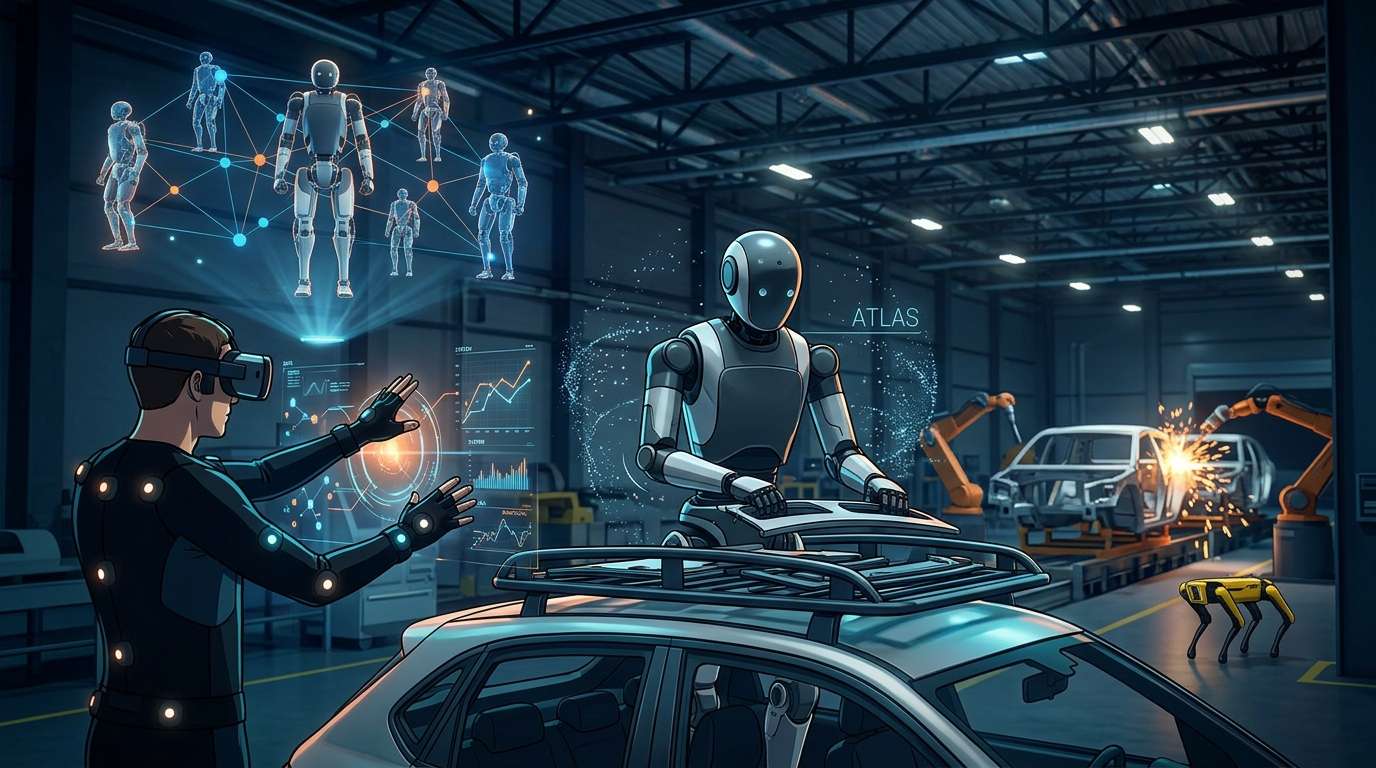
Boston Dynamics’ humanoid robot Atlas is reportedly sorting roof racks at a factory owned by its parent company, South Korea’s Hyundai, without human intervention. Development is led by Zack Jackowski. It could be several years before Atlas becomes a permanent fixture at a factory, highlighting the distance between the promise and practical deployment.
Learning factory work from human movement
In 2021, Atlas was a large hydraulic robot good at running and jumping. Its movements were based on algorithms written by engineers. The current next-generation model has a slimmer, fully electric body, is equipped with an NVIDIA chip and learns to move using AI. At 175 cm tall and weighing 90 kg, it is roughly the size of an adult man.
The training has two parts. One is remote operation. An operator wearing a VR headset directly moves Atlas’s arms and hands, demonstrating tasks one at a time. The resulting recordings serve as training material for an AI model to learn how to perform tasks autonomously. A suit that records full-body motion is also used, with sensors capturing walking and hand movements.
The other part is simulation. Because humans and Atlas have different body structures, the robot cannot simply copy human movements. Instead, more than 4,000 digital Atlas robots were trained in a virtual environment for six hours. Challenging conditions, such as slippery floors and stiffened joints, were added, and the movements were adapted to suit the robot’s body.
When one robot learns, they all learn
One notable advantage is how easily learning can be shared. When one robot acquires a new skill, it can reportedly be rolled out to every unit running the same AI. Humans need to be trained one by one, but a skill can be copied to robots in an instant. I think this is why companies invest so heavily in making the first unit smart.
Using the same methods, Atlas also learned to crawl and do backflips. It reportedly struggled, however, with a ducklike walk. Even robots that seem versatile have clear strengths and weaknesses.
It can carry parts, but not coffee
While Atlas can sort parts at a factory, everyday tasks such as getting dressed in the morning, pouring coffee and carrying it around the house are still a challenge. The things we do without thinking are often the hardest for robots. There is still a gap between the versatility suggested by a humanoid’s appearance and what it can actually do.
That is why companies considering adoption need to look beyond polished demo videos and find out what tasks a robot can handle—and how reliably. At Hyundai’s factory, more than 1,000 robots work alongside about 1,500 people, lifting, pressing and welding. The site illustrates how robots excel at routine tasks, while the value of humanoid robots lies in how far they can venture beyond them.
Another point to watch is the robot’s brain. NVIDIA chips process the data Atlas gathers, helping it observe its surroundings and understand how the physical world works. Atlas is said to be moving closer to something like common sense. The vision for the future is a robot stationed in a factory that will act simply by being told in words what to do.
Beyond job-loss fears, a new role in robot operations
There will certainly be people who say, “Robots are taking our jobs.” Robots are likely to take on monotonous, physically demanding tasks over time. Changes to the nature of work will be unavoidable.
But robots do not simply work on their own. People are needed to build, train and maintain them. Robert Playter, former CEO of Boston Dynamics, has also highlighted the need for that kind of oversight. Atlas could take several years to become a permanent part of the Hyundai team.
Goldman Sachs forecasts that the humanoid market will reach $38 billion within 10 years. As the market grows, new roles will emerge on the factory floor: people who train, monitor and repair robots. The question should not be “Will jobs disappear?” so much as “How will roles on the factory floor be reshaped?”
A path that began with Spot, the four-legged robot
Atlas’s predecessor is Spot, a doglike robot introduced about a decade ago. Equipped with multiple cameras, thermal sensors and acoustic sensors, Spot performs quality checks at Hyundai’s factory to confirm that the required parts are installed on cars. It also conducts safety inspections and equipment patrols at hundreds of facilities around the world. The experience gained operating Spot in real-world settings appears to be carrying over to Atlas.
The competition extends beyond the United States. Tesla, startups backed by Amazon and NVIDIA, and Chinese state-owned companies are vying to develop humanoid robots. Hyundai owns an 88% stake in Boston Dynamics and is investing to stay among the leaders. The prospect of robots working alongside people is taking shape through both technology and investment.


Comments